

Fall is patio season in Austin. The August heat finally breaks, the backyard is usable again, and every September we watch searches for patios and flagstone climb as people plan the space they gave up on all summer. If you are collecting quotes now, the first question is always the same: what does a patio actually cost here?
We design and build patios across Austin and the Hill Country, from dry-laid flagstone to concrete pavers to poured slabs. This guide gives you real per-square-foot ranges, worked examples at 12 by 12 and 20 by 20, and the local stuff that moves the number: our clay, our limestone, base prep, and the city's rules. Treat every figure as a planning range, not a quote.
How much does a patio cost in Austin?
Most patios we build in the Austin area land in these ranges, installed and including base prep:
- Plain broom-finish concrete: about $8 to $16 per square foot
- Stamped or colored concrete: about $14 to $26 per square foot
- Concrete pavers, dry-laid on a compacted base: about $16 to $32 per square foot
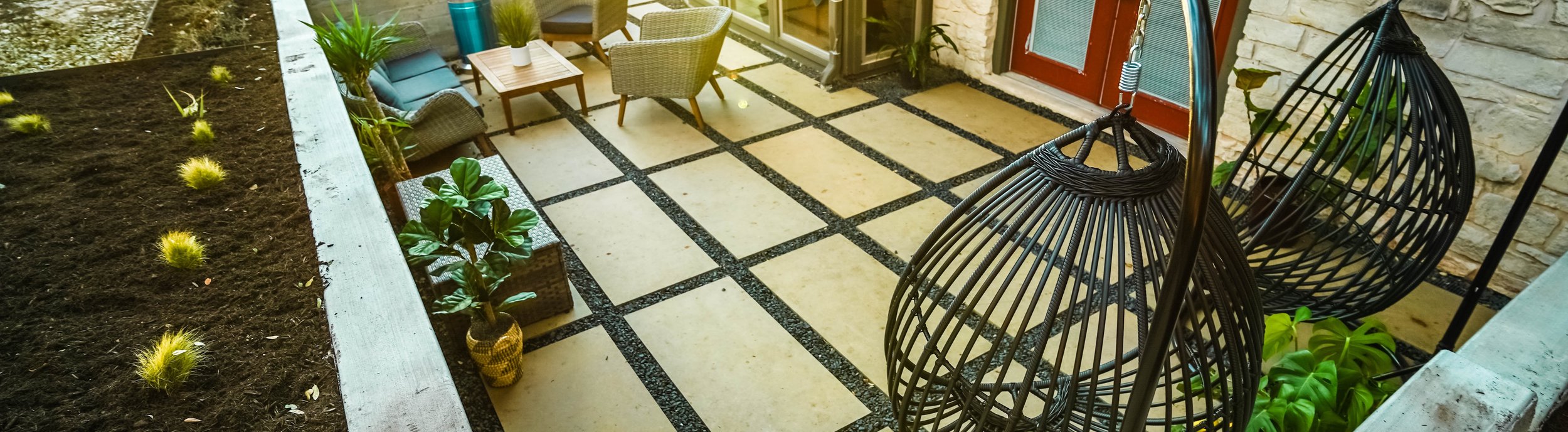
- Flagstone, dry-laid on gravel or sand with gravel joints: about $18 to $35 per square foot
- Flagstone, mortared onto a concrete slab: about $30 to $50 per square foot
A small, square, easy-access patio on flat ground sits at the low end. Rock excavation, a sloped or tight-access yard, demo and haul-off of an old slab, a thicker base, premium stone, and fancy patterns all push toward the top. Mortared flagstone costs the most because you are paying for two builds in one: a concrete slab first, then a mason setting and grouting every piece on top.
What does a 20x20 flagstone or paver patio cost?
Take the per-foot ranges and do the math. A 12 by 12 patio is 144 square feet. A 20 by 20 is 400 square feet.
12 by 12 (144 sq ft):
- Concrete: about $1,150 to $2,300
- Concrete pavers: about $2,300 to $4,600
- Dry-laid flagstone: about $2,600 to $5,000
20 by 20 (400 sq ft):
- Concrete: about $3,200 to $6,400
- Concrete pavers: about $6,400 to $12,800
- Dry-laid flagstone: about $7,200 to $14,000
- Mortared flagstone: about $12,000 to $20,000
So if you searched "average cost of a 400 square foot paver patio," you are looking at roughly $6,500 to $13,000 for a professionally built one here, and a 20 by 20 flagstone patio runs a bit more. A smaller 12 by 12 landing is the easiest way to get real stone for a smaller number.
Is flagstone cheaper than pavers or concrete?
Honest answer: plain concrete is almost always the cheapest patio up front. A broom-finish slab is quick to pour and uses the least labor, so it wins on sticker price.
After that it gets closer than people expect. Dry-laid concrete pavers and dry-laid flagstone overlap a lot, because both are really a base-prep job with a surface on top, and the base is where the hours go. The flagstone itself often costs more than pavers, but a clean paver pattern can take just as long to set. Mortared flagstone on a slab sits at the top of the list every time.
Which patio holds up best on Austin clay and limestone?
The right answer depends on which side of town you are on, because Austin is really two different ground problems.
East and north, in places like Round Rock, Pflugerville, Cedar Park, and Hutto, a lot of newer homes sit on deep expansive clay. Texas A&M AgriLife Extension describes these blackland soils as clays that "shrink and swell when exposed to moisture, forming wide cracks and heaving objects like fence posts and patios." That movement is why a rigid concrete slab can crack along a line and never go back. Pavers and dry-laid flagstone have an edge here: the joints let the surface flex with the ground, and if a section settles we can lift it, fix the base, and reset it. You cannot reset a cracked slab.
West, in Westlake Hills, Lakeway, and Steiner Ranch, the problem flips. Soil is thin over solid limestone, so the ground barely moves, but digging is slow and a sloped lot often needs a retaining wall to carve out a level patio at all. That is its own line item, and we break it down in our retaining wall cost guide.
Heat matters too. Lighter stone and pavers run cooler underfoot than dark concrete in August, which is a real thing when you are barefoot on the way to the grill. Local Texas and Oklahoma flagstone and Hill Country limestone are stocked by Austin stone yards, so the material that looks at home here is also the material that is easy to get here. As for whether flagstone is outdated, we do not see it. Natural stone still reads as the high end of a backyard.
What goes under a patio, and why does base prep drive the price?
Almost the entire difference between a patio that stays flat and one that sinks is under the surface, where you never see it. A patio is built in layers: excavate down to firm ground, lay and compact a crushed-stone base, add a bedding layer of sand or a mortar setting bed, set the surface, lock the perimeter with a solid edge restraint so nothing spreads, and slope the whole thing slightly away from the house so water runs off.
That slope is not optional in Austin. Our rain comes in bursts, and a patio that drains toward the foundation feeds water exactly where you do not want it. On bigger jobs we tie the grading into a French drain to carry runoff away. A paver is only as good as what is under it, and the concrete paver industry's installation standards call for units set on a compacted aggregate base and a bedding layer. Our clay usually calls for a deeper base than a well-drained lot up north. When two quotes are far apart, a thin base is often the reason the cheap one is cheap, and you pay for it later when the surface goes wavy.
What are the downsides of flagstone and pavers?
No patio is perfect. The honest trade-offs:
- Flagstone has an uneven surface, so a bistro table can rock and a chair can catch. Cut stone with tighter joints helps.
- Gravel or sand joints can wash out in a hard storm and grow the occasional weed, so they need topping up now and then.
- Mortared joints crack when the clay under them moves. It looks like a flaw, but it is the ground talking, not bad work.
- Pavers can shift or dip if the base was thin or the edges were not restrained. Sunken pavers and cracked mortar joints are a big share of the repair calls we get.
- Sealing is optional upkeep. It deepens the color and helps with stains, but skip it and the patio still works. Just know it is a chore you are signing up for if you want that wet look.
What is the cheapest patio that still holds up in Austin?
If the budget is tight, three moves get you a patio that lasts without the top-end price:
- Flagstone set with gravel or decomposed granite joints instead of mortar. You skip the concrete slab underneath and get a surface that drains. We use this all over, and our guide to decomposed granite and water-wise hardscape walks through the material.
- Plain broom-finish concrete. Not fancy, but honest and cheap, and you can dress it up later with a border or by extending it with gravel walkways.
- A smaller footprint. A right-sized 12 by 12 patio in real stone often beats a big slab you never fully use.
What we steer people away from is loose stone dropped on dirt. It is the cheapest thing to install and the fastest thing to fail.
Do you need a permit or HOA approval for a patio in Austin?
For a ground-level patio, usually no city building permit. The City of Austin lists residential "concrete flatwork that is not located in the public right-of-way" among the work exempt from a building permit, and a patio at grade falls in the same bucket. Add a roof or a structure attached to the house and that changes.
The bigger limit is impervious cover. Patios count as impervious cover in Austin, and most single-family lots are capped around 45 percent of the lot, with some watersheds like the Barton Springs Zone much stricter. Do not assume gravel joints or "pervious" pavers buy you extra room: the city gives little or no impervious-cover credit for them on a typical residential lot, and mortared flagstone counts as solid cover. Check your lot's limit with Austin Development Services before you size the patio.
Then there is the HOA. In master-planned communities the architectural committee usually has to approve hardscape before you build. Circle C's committee reviews hardscape improvements, and Steiner Ranch requires approval for exterior and landscape work. Cities around Austin like Round Rock, Cedar Park, Lakeway, and Westlake Hills each write their own rules, so check locally. We handle the permit and HOA paperwork as part of the project.
How do you compare patio quotes in Austin?
Two patio quotes can be thousands apart and both be honest, because "patio" hides a dozen choices. Texas does not license landscapers or masons, so anyone can print a bid. The one exception is irrigation: the state requires a TCEQ-licensed irrigator to touch a sprinkler system. Everywhere else it is on you to compare the work, not just the price. Ask every bidder:
- How deep is the base, and what is it made of
- Is there an edge restraint around the perimeter
- How does the patio drain, and which way does it slope
- Who pulls the permit and handles the HOA paperwork
- Is demo, haul-off, and grading included
- What is the warranty, and what happens if it settles
When the base, drainage, and edge details match, the quotes usually move a lot closer together. A low bid with a thin base and no haul-off is not the same product as a higher bid that builds the patio to last.
Ready to build a patio that stays flat?
A patio is the floor of your whole backyard, so we design it with the shade, lighting, drainage, and planting around it as one plan instead of a slab someone pours and leaves. We build flagstone patios like the one under the live oaks in Bee Cave, the trellis-shaded patio in Lakeway, and the fire pit and seating wall on a Steiner Ranch project, plus paver patios and walkways from central Austin out to Driftwood, all through our design-build process.
If you are planning a patio this fall, call Thrive Landscape and Design at (737) 321-7812 or request a consultation and we will walk your yard and give you a number you can actually compare.