

Austin yards do not sit flat. West of town, lots drop away fast over thin soil and solid limestone. East of town the ground is deep clay that swells when wet and shrinks when dry, taking your grade with it. Our rain makes both worse: weeks with nothing, then a storm that drops it all at once.
Fall is when people finally deal with the slope. We design and build retaining walls across Austin and the Hill Country, and we get called to rebuild walls stacked with no drain behind them. Here is what a wall costs, why bids land far apart, and the permit rule most homeowners miss.
How much does a retaining wall cost in Austin?
Most residential retaining walls in Austin land between roughly $40 and $100 per linear foot for a short segmental block or limestone wall. Taller engineered walls, boulder walls, and walls that need heavy digging in caliche or limestone can run $150 per linear foot or more.
Length is only half of it. Height moves the price faster than length does, because a taller wall needs a deeper base, more drainage stone, reinforcement, and often an engineer. That is why some builders price by the square foot of wall face instead: length times height, counting the part buried below grade. If one bid is by the foot and another is by the square foot, ask both for the wall's length and height so you can compare them.
How much does a 4-foot retaining wall cost?
Four feet is the height everyone asks about, because that is where the city's permit rules start. A wall that tall is past the short garden wall range, so plan on $100 to $150 per linear foot or more. Take a 4-foot wall running 30 feet:
- 30 feet x $100 = about $3,000
- 30 feet x $150 = about $4,500
Planning numbers, not a bid.
How much does a 100-foot retaining wall cost?
Length alone does not answer it. You need the height too:
- Short block or limestone wall: 100 feet x $40 to $100 = about $4,000 to $10,000
- Tall or engineered wall, boulders, or heavy rock digging: 100 feet x $150 = $15,000 and up
Why are retaining wall quotes in Austin so far apart?
Because "retaining wall" describes a dozen different jobs.
- Rock. West of I-35, soils are thin over limestone, as Texas A&M AgriLife Extension in Travis County describes. Hit rock or caliche in a footing trench and digging slows.
- Height. A taller wall carries much more load, so base, reinforcement, and engineering all step up together.
- Drainage behind the wall. Gravel backfill, a perforated pipe, filter fabric, an outlet. You never see it, and it decides if the wall lasts.
- Access. Machines build fast. Gravel hauled by hand through a side gate does not.
- Engineering and permits. Above permit height, add a permit and, in most cases, an engineer's stamped design.
- Tear-out. Removing a failed wall and hauling off the debris is its own line item.
- What sits above the wall. A driveway, a pool, or more slope pushing from behind all add load.
Limestone, concrete block, or poured concrete: which wall is right for your yard?
Block is the value pick, limestone is the local look, boulders handle the steep stuff, and poured concrete is the modern one.
Natural limestone, dry-stacked or mortared, suits garden walls, planters, and terraces where the wall is part of the view. It gets set by hand, so labor runs higher than block.
Segmental concrete block locks together unit by unit, and above a few feet it takes geogrid, mesh laid back into the soil so the hill and the wall work as one mass.
Boulder walls handle steep grades and big elevation changes, and they suit rocky lots on the west side where the stone already looks at home.
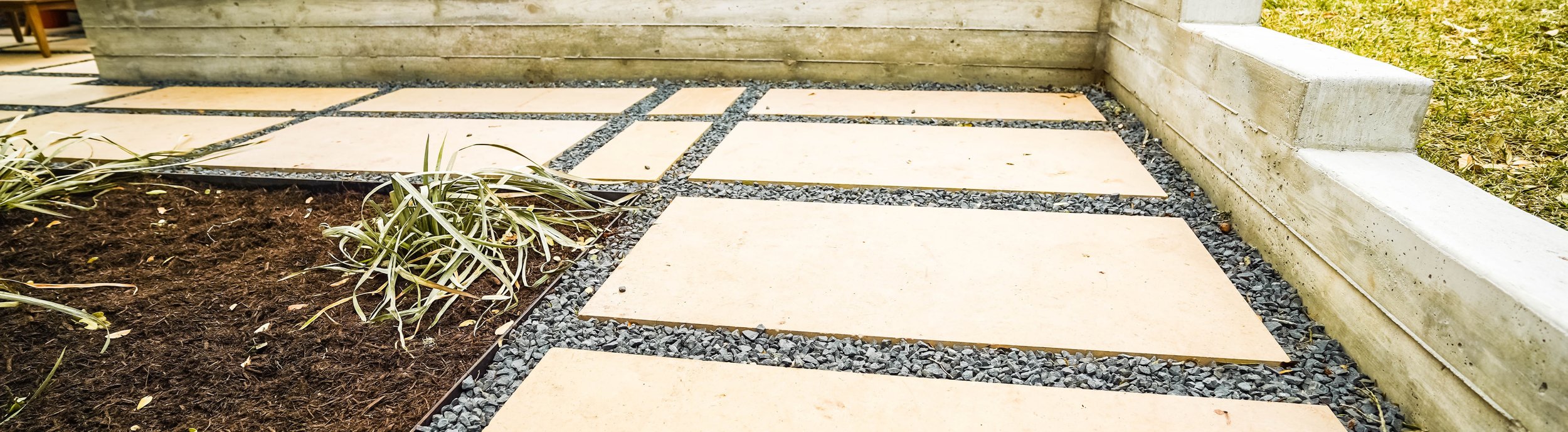
Poured concrete gives the flat, quiet face modern homes ask for. On our Shoal Creek terrace project, board-formed walls with steps built into them made the wall and the path down to the patio one piece. Forms add cost.
What is the cheapest retaining wall, and is a wood wall worth it?
Treated timber is cheapest up front. The catch: wood in ground contact rots, and the ground is where a retaining wall lives. It has the shortest life of any wall material, and when it goes you pay to rebuild.
The better answer to "cheapest" is usually less wall:
- A shorter wall. Price climbs with height, so a foot less wall saves real money.
- Two low walls instead of one tall one. Terracing works if the walls sit far enough apart, and an engineer should confirm the spacing.
- Regrading first. Sometimes reshaping the yard lowers the wall you need, or removes it.
Do you need a permit for a retaining wall in Austin?
Inside Austin city limits, the city lists this as exempt from a building permit: "Unless supporting a surcharge or located within a flood hazard, a retaining wall that is not over 4 feet in height measured from the bottom of the footing to the top of the wall." That sits on the City of Austin list of work exempt from building permits.
The measurement starts at the bottom of the footing, not at the grass. Because the footing sits below grade, a wall showing about 3 feet of face can still be over 4 feet by the city's measure.
A surcharge is extra load on the soil behind the wall: a driveway, a structure, or a slope that keeps climbing. A short wall holding up a driveway is not exempt. Walls above that line, or holding up a driveway or pool, generally need a licensed engineer's stamped design, and we coordinate that as part of design-build. The city adds that an exemption does not authorize work that violates other City Code provisions.
What if you are outside Austin city limits?
Travis County has its own residential retaining wall permit for property outside city limits. The site plan must show the type and location of the wall and the elevation of its top and bottom. Over 5 feet tall, the site plan must be sealed by a Texas licensed engineer. See the Travis County residential retaining wall permit page.
What about West Lake Hills and other hillside cities?
The smaller cities around Austin write their own rules. West Lake Hills city code says any wall shall not exceed six feet in height above natural grade, and walls must use native materials or earth-tone colors that match native soils. Any wall three feet or taller needs shrubbery or vines at least two feet tall at planting, set in front to form a continuous screen that grows to the height of the wall. Confirm the current code with the city.
What else can stop a wall before it starts?
- HOA approval. In Circle C, Steiner Ranch, Lakeway, and other HOA neighborhoods, expect a design review.
- Protected trees. Austin does not regulate residential trees under 19 inches in diameter, but protected and heritage trees are regulated. In a regulated tree's critical root zone, nothing may touch the inner quarter, no cut or fill deeper than 4 inches is allowed in the inner half, and half the full zone must stay undisturbed, per the City of Austin page on trees on residential property. Cut and fill is what a wall does, so a big oak can move it.
- 811. Texas law requires contacting 811 two business days before digging. It is free, and your contractor makes the call.
Why do retaining walls fail in Central Texas?
Water, almost every time. Wet soil pushes far harder on a wall than dry soil, so a wall with nowhere to send water carries a load it was never built for. The rebuilds we get called to show the same list:
- No gravel and no pipe behind the wall. Backfilled with the dirt that came out of the trench. Dirt holds water, and water pushes.
- No compacted base below grade. The first course settles unevenly and the wall goes out of line.
- Clay doing what clay does. East of I-35, AgriLife describes deep clay that shrinks and swells with moisture, opens wide cracks, and heaves fence posts and patios.
- Built taller than its design. A course added later turns a good wall into a leaning one.
- Downspouts dumping behind the wall. Roof water arrives all in one spot.
The fix: compacted base, clean gravel, a perforated pipe with a real outlet or weep holes, and filter fabric over the gravel. On bigger slopes that drain ties into a French drain, priced out in our French drain cost guide.
Can a retaining wall fix erosion on a sloped Hill Country lot?
Yes, when the slope is too steep to hold its own soil. But a wall is one tool, not the whole fix.
On hillside lots in Westlake Hills, Lakeway, Steiner Ranch, and River Place, soil is thin over limestone, so roots have little to grip and runoff picks up speed. Terracing into two or three levels usually beats one tall wall, and we pair it with erosion control: a dry creek bed for overflow, regrading above the wall, and deep-rooted native planting between terraces. Our guide to Hill Country backyards shows where that leads.
East of I-35, in Pflugerville, Hutto, and the east side of Round Rock, solid rock is rarely found, so digging is easier. The clay runs deep and moves with the seasons, so walls there live or die on drainage.
How do you compare retaining wall quotes?
Check that the bids describe the same wall. A good quote spells out:
- The wall's length and height, whichever way they price it
- Height measured from the bottom of the footing, not from the lawn
- Base depth and material, compacted
- The drainage detail: gravel, pipe, filter fabric, and where the water comes out
- Who handles engineering and the permit, and whether it is in the price
- Haul-off of spoil and old wall material
- What happens if they hit rock
If a quote has no drainage line item, you have your answer. We build walls as part of design-build, so design, engineering, permit, and crew stay under one roof.
Ready to build a wall that stays put?
We design and build retaining walls, terraces, and the drainage behind them across Austin and the Hill Country. Call Thrive Landscape and Design at (737) 321-7812 or request a consultation for a real number on your slope.