

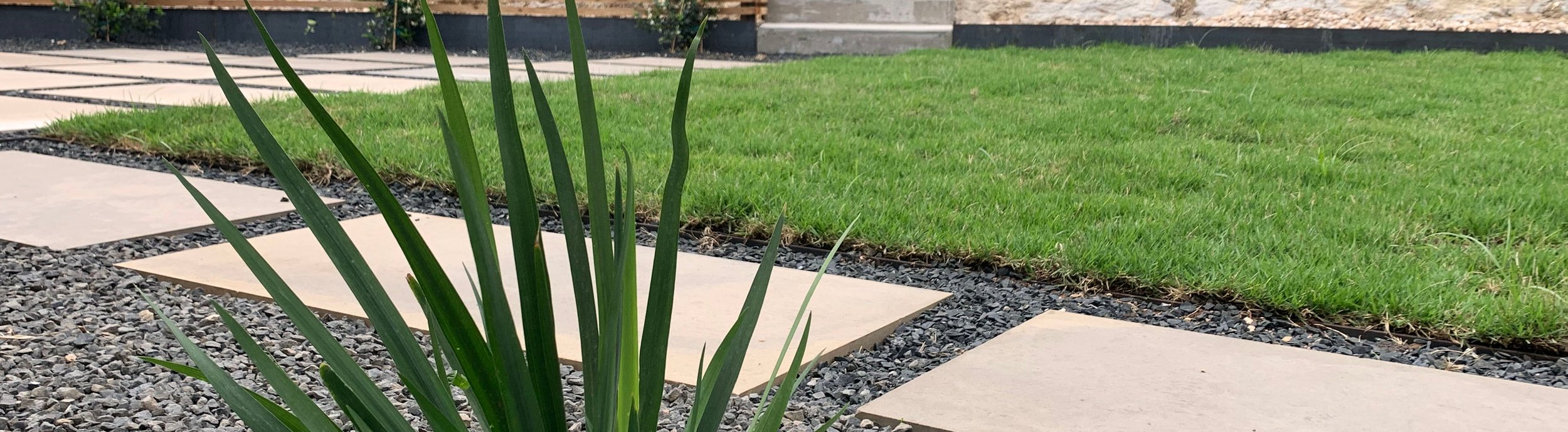

A backyard in Westlake Hills or Lakeway has something most of Central Texas doesn't: elevation, long Hill Country views, and in many cases a sightline to Lake Austin or Lake Travis. That's the raw material for a resort-style yard, the kind where a pool seems to spill toward the horizon, an outdoor kitchen anchors the evening, and terraced gardens step down the slope like they were always there.
It's also some of the trickiest ground to build on in the region. Steep grades, shallow limestone, heavy deer pressure, protected heritage oaks, and strict water-quality rules all sit between the vision and the finished space. Getting it right takes backyard design that respects all of it, which is what we do for our Westlake and Lakeway clients. The projects that go wrong almost always skipped the same homework.
What "resort-style" actually means on a Hill Country lot
Resort-style describes how the whole space works together, not one standout feature. The backyards that pull it off read as a single connected space: a pool or spa as the centerpiece, a shaded outdoor kitchen and dining area, soft terraced planting, warm low-voltage lighting, and a fire feature for the handful of cool nights we get. The goal is a space you'd happily fly somewhere to visit, except it's off your back door.
On a flat suburban lot, you lay those elements out side by side. On a Westlake or Lakeway hillside, you stack them. Good design uses the grade instead of fighting it: a pool terrace on one level, a kitchen and lounge on another, planting beds cascading between them. The slope stops being a problem and becomes the best thing about the yard.
Start with the slope: terracing and retaining walls
The defining challenge out here is the terrain. West of Austin you're building on thin soil over limestone and caliche, often on grades that would be unbuildable without engineering. Before any pool or patio gets drawn, the land has to be shaped into usable, stable levels.
That's a job for retaining walls and proper landscape construction. We design walls that hold the hillside, create flat "rooms" for living space, and look like a deliberate part of the landscape rather than a fix. The same grading work has to solve drainage at the same time. On a slope, every hard surface you add sends more water downhill faster. We build the drainage into the terracing from day one so the first big Hill Country downpour doesn't undercut the investment.
Work with the rules, not against them
This is where ambitious backyards in this area succeed or stall. Westlake Hills and Lakeway have some of the strictest site rules in Central Texas, and a resort-style yard (pool, patios, kitchen, decking) adds a lot of impervious cover.
The City of West Lake Hills caps impervious cover at roughly 55% of the lot, with only a narrow path to more by city council approval, and it recently tightened its drainage and erosion-control standards. Any meaningful increase in hard surface triggers permits and a site plan. It's worth confirming the current numbers and process on the city's Building & Development page before you fall in love with a layout. Lakeway runs its own permitting and most neighborhoods there sit under an HOA with its own design review on top of that.
There's a second layer most homeowners don't know about: much of this area sits over the Edwards Aquifer's recharge and contributing zones, which means water-quality protection shapes what you can build and how stormwater has to be handled. The TCEQ Edwards Aquifer Protection Program is the governing framework, and it's a real factor in how we size patios, route runoff, and choose permeable surfaces. Designing within these limits from the first sketch keeps the build moving instead of stalling in a redesign halfway through. We handle that part for you.
Protect the heritage oaks
The mature live oaks on these lots are worth a fortune and impossible to replace on any human timeline, and they're often the first casualty of careless backyard construction. Oak wilt is at epidemic levels in Central Texas, and it spreads through fresh wounds: a nicked trunk from an excavator, a cut root, a poorly timed pruning.
We design around root zones, not through them, and we follow the Texas A&M Forest Service guidance on oak wilt prevention: avoiding pruning during the high-risk window of roughly February through June, and painting every oak cut immediately, no matter the season. A resort-style yard built under a canopy of healthy old oaks is worth far more than one that cost the trees to build.
The outdoor living core
With the levels shaped and the trees protected, the fun part comes together. For most of our Westlake and Lakeway clients the core is some combination of:
- A pool or spa terrace positioned to catch the view and the afternoon shade
- An outdoor kitchen with real counter space, built into a paver or natural-stone patio that ties back to the home's materials
- Pergolas and shade structures that keep the space usable through a July afternoon
- A fire feature that extends the season and gives the space a center of gravity after dark
The transitions are what make it work: how the kitchen level steps down to the pool, how a path of stone treads moves you through the planting, how each "room" feels connected but distinct.
Plant it for deer and drought
Two realities govern planting here. First, the deer. Browse pressure in Westlake and Lakeway is relentless, and a tender, thirsty plant palette becomes an expensive deer buffet. We lean on tough, deer-resistant, native and adapted species (Texas sage, salvia greggii, Texas mountain laurel, agave and yucca, ornamental grasses) that hold the design even when the herd moves through. The Lady Bird Johnson Wildflower Center, right here in Austin, keeps an excellent deer-resistant native plant list if you want to see what thrives.
Second, the water. A resort look does not require a thirsty landscape. In fact, the best-looking Hill Country yards are built around water-wise planting. We hydrozone the beds, mulch heavily, and use the right native plants for the heat so the yard looks fuller every year on less water.
Water it smart
Lakeway sits on Lake Travis, and the whole region draws its water from the Highland Lakes, which the LCRA manages through wet years and dry ones alike. Watering rules shift with conditions, so we design irrigation that performs no matter what stage we're in. Drip irrigation feeds the beds at the root zone, and a smart controller adjusts to the weather and skips cycles after rain. You get a lush, resort-grade landscape without a punishing summer water bill, and without a yard that looks neglected the moment restrictions tighten.
Light it to live in it after dark
The feature that makes a backyard feel like a resort is almost always the lighting. Warm, layered landscape lighting turns the terraces, oaks, and water into a nighttime scene, makes the steps and paths safe on a sloped lot, and stretches every evening outdoors well past sunset. It's a small part of the budget that changes how the whole yard feels at night.
Build it with a team that knows this ground
A resort-style backyard in Westlake Hills or Lakeway is one of the most rewarding projects a homeowner can take on, and one of the least forgiving if it's designed without respect for the slope, the rules, the trees, and the water. That's the work we do every week across Westlake Hills and Lakeway.
Take a look at our recent projects to see how we handle hillside lots, then request a consultation. We'll walk your property, talk through the views you want to capture and how you like to live outside, and design a backyard that fits the lot, the rules, and the way you want to use it.