
Most people start pricing a driveway gate right after something happens. A stranger turns around in the driveway at 2 a.m., the dog makes it out to the county road, or a delivery driver leaves the ranch gate open again. Then the search starts, and prices online run from a $2,000 kit to a $30,000 estate entry.
We design and build automatic driveway gates across Austin and the Hill Country, from sloped estate entries in Westlake Hills to long caliche drives outside Dripping Springs. This guide covers what a gate really costs here, swing vs. slide, solar vs. hardwired power, and the safety and permit rules that should shape the build.
How much does an automatic driveway gate cost in Austin?
Most automatic driveway gates we build in the Austin area run about $7,000 to $25,000 installed. That covers the gate, posts or columns, opener, safety devices, and access control. Typical ranges:
- Single swing gate, 12 to 16 feet, steel or cedar on a steel frame, power close by: about $7,000 to $11,000
- Double swing gate, 16 to 20 feet, custom steel, keypad and remotes: about $11,000 to $18,000
- Slide or cantilever gate on a slope or tight entry: about $14,000 to $25,000
- Limestone columns, a long power run, or a video intercom: push any of these toward the top, or past it
National cost guides often quote $2,000 to $6,000. Those numbers usually assume a light kit gate on flat ground with an outlet nearby. Austin entries rarely look like that once you add rock, slope, and a gate heavy enough to suit the house. Treat our ranges as planning numbers, not a bid.
Why does one gate cost $7,000 and another $25,000?
Five things move the price most:
- Width and weight. A wider, heavier gate needs a stronger opener, bigger posts, and deeper footings.
- Swing or slide. Slide gates need a track or cantilever frame and more steel.
- Power. A hardwired opener needs a circuit run to the gate. Solar skips the trench but adds a panel and batteries.
- Columns and ground. On many west side jobs we drill through caliche and limestone to set posts. Stone columns add masonry and footings.
- Access control. A keypad is a small add. A video intercom with phone app control costs more, but you use it every day.
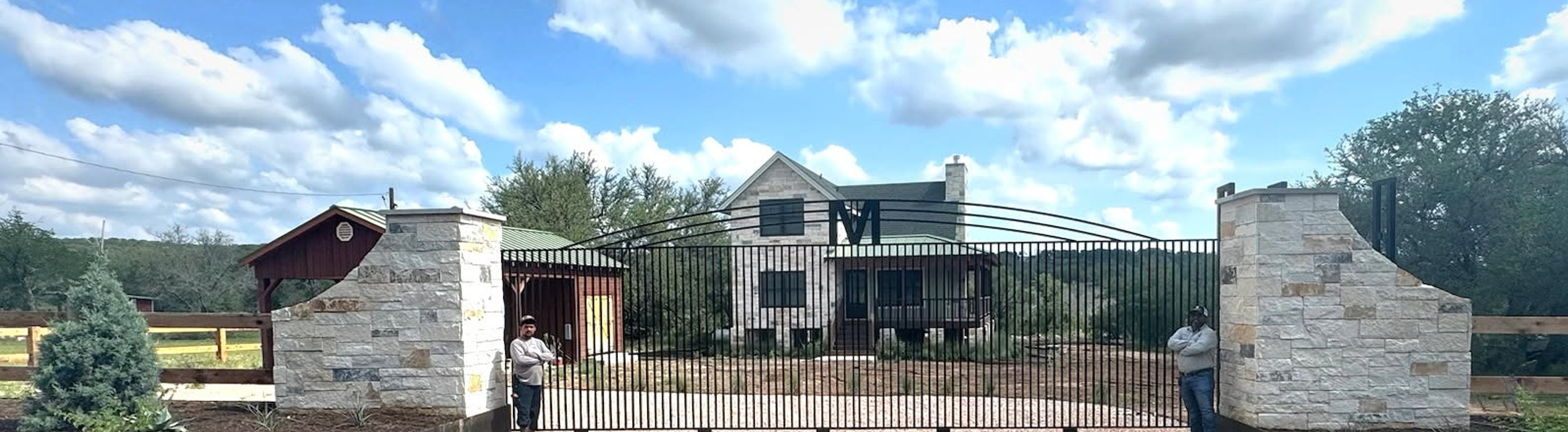
On a ranch property outside Smithville, the gate was only one piece of the job. We built limestone columns, hung a black steel gate with an arched top between them, and ran iron fencing along the road frontage. That is why two quotes for "a gate" can be so far apart.
Should you choose a swing gate or a sliding gate?
It comes down to slope, side room, and budget.
Swing gates
A swing gate is the classic estate look, and it usually costs less. It needs a fairly level arc to open into and room so it does not hit a parked car. If your driveway climbs up from the street, a gate swinging inward will hit the slope before it opens all the way. Never plan a gate that swings out toward the road.
Slide and cantilever gates
A slide gate rolls sideways across the opening, so the slope in front and behind matters much less. A cantilever gate rides on rollers beside the opening, with no track across the driveway, which helps where gravel, leaves, or washouts would foul a track. The catch is side room: you need a clear, fairly level run along the fence at least as long as the opening, and a cantilever needs more.
On steep drives in Westlake Hills and Lakeway, a slide or cantilever gate is often the only type that opens cleanly. The ASTM F2200 gate construction standard also says a gate should not start moving by gravity once it is unhooked from its opener, so a gate on a grade has to be designed for that slope from day one.
Is a solar gate opener reliable, or should you run power to the gate?
Solar works well when it is sized right. A solar opener runs on batteries, and a panel recharges them during the day. On long drives in Dripping Springs, Driftwood, and Wimberley, the house can sit hundreds of feet from the road, and trenching power that far through limestone can cost more than the whole solar setup.
Here is how we decide:
- Go solar when the gate is far from power, opens a modest number of times a day, and the panel can see open sky most of the day.
- Run power when the gate sees heavy traffic, the panel would sit under live oaks, or you want a heavy gate, video intercom, and entry lights on one system.
- Size for winter, not June. The short days of December give a panel the least sun, so we size panels and batteries for winter. Batteries also wear out, so plan on replacing them every few years.
A hardwired opener needs a new outdoor circuit, and that is a job for a licensed electrician.
Steel, wrought iron, or cedar: which gate holds up in Central Texas?
- Powder coated steel is what we build most. It suits a ranch or modern entry and pairs well with limestone columns. Ask for steel that is galvanized under the powder coat, and touch up chips before rust starts.
- Wrought iron is mostly a style today. Nearly every gate sold as wrought iron is made of steel, so the same care applies.
- Aluminum does not rust and is light, which is easy on an opener. It dents more easily and can look thin across a wide entry.
- Cedar reads warm and ties the gate to a wood fence. A big all-wood gate sags and twists in our sun, so we build cedar and slat gates on a steel frame.
A solid privacy gate also catches wind like a sail, so it needs a stronger opener than an open picket gate of the same size. And inside Austin city limits, the city's Safe Fencing rules have banned spiked pickets and spear points above the top rail on new fences since July 31, 2023. We design gate tops the same way: flat, or with the pickets kept under the top rail.
We match the gate to metal fencing or a custom mixed-material fence so the entry and the fence line read as one design.
What are the downsides of an automatic gate?
- Safety. A moving gate is heavy equipment. Current UL 325 rules require monitored safety devices, such as photo eyes and contact edges, at the spots where a gate could pin someone. Openers built to the current standard will not run without them.
- Power outages. Every opener needs a manual release, and battery backup keeps a hardwired gate working through an outage. Make sure everyone at home knows how to release it.
- Upkeep. Hinges, rollers, and tracks need cleaning and adjustment. In Central Texas, fire ants move into electrical boxes and can short out controls, so check the opener housing a few times a year.
- Emergency access. Round Rock's fire marshal, for example, requires a Knox key switch on automatic gates across fire lanes and a gate that opens by hand when the power fails. A single home's driveway is usually not a fire lane, but rural fire districts may still ask for a key switch or code. We check before we build.
- Night use. A keypad you cannot see in the dark gets old fast, so we usually add security lighting at the entry.
Do you need a permit or HOA approval for a driveway gate in Austin?
Inside Austin city limits, plan on the gate following the same rules as the fence it sits in. Per the city's fencing regulations, you need a permit if any part of the fence is more than 7 feet high, is in a floodplain, or is more than 6 feet high along a public street right of way. Tall columns or an arched top can push you past 7 feet, so we measure that during design. In the city's Wildland-Urban Interface areas, fences over 6 feet may also need review.
West Lake Hills, Lakeway, Bee Cave, and Dripping Springs write their own rules, so we check with each city first.
The approval that stalls most gates is the HOA. Steiner Ranch, Westlake Hills, and Lakeway HOAs review gate height, material, and color. We draft the submittal and wait for approval before we order steel.
Set the gate back far enough that your car can pull completely off the street while it opens. That often means a wider driveway apron, and our driveway cost guide covers what paving costs.
Is a gate kit from a big-box store worth it?
For a pasture gate you open twice a day, maybe. For your main entry, usually not. Kits are sized for light gates and light use, their hardware is not built for limestone, and safety devices are sometimes sold separately. We get called to replace kit openers that burned out pushing a gate heavier than they were built for.
If you go the kit route, make sure the opener is UL 325 listed for residential vehicle gates and rated for your gate's weight and length, and install every safety device the manual calls for.
Who installs automatic gates in Austin, and how do you compare quotes?
A gate job crosses three trades: fence building, metal fabrication, and low-voltage electrical work. Look for one team that owns all three, so nobody points fingers when the gate stops closing. Check that each quote lists:
- Gate size, material, finish, and type (swing, slide, or cantilever)
- Opener brand, model, duty rating, and power source
- Every safety device included
- Columns or posts, and footing depth
- Access control, HOA submittal, permits, and electrical work
- Warranty, and who you call for service
Ask whether the installer has formal gate automation training, such as the American Fence Association's Certified Gate Automation Technician credential. Our fence cost guide covers reading a quote line by line. Most gates take two to five weeks from the first site visit to final programming, longer for custom iron work, new columns, or HOA review.
Ready to price your gate?
We will walk your entrance, measure the grade, check where power is, and give you an itemized estimate with honest options. Call us at (737) 321-7812 or request a free estimate to get started.