
Searches for driveway contractors in Austin climb in the fall, and the reason is easy to see from the curb. The summer heat is gone, the cracks that opened during the dry months are still there, and people want the front of the house fixed before family shows up for the holidays. The first question is always the same: what does a new driveway cost here?
We design and build driveways across Austin and the Hill Country. Most of ours are concrete pavers, brick, natural stone, or permeable pavers, plus crushed stone and decomposed granite on long rural drives. We do not pave asphalt. This guide gives you planning ranges per square foot, worked examples, and the local issues that move the price: our clay, our limestone, the city's right-of-way rules, and HOAs. Treat every number as a planning range, not a quote.
How much does a new driveway cost in Austin?
Most residential driveways in the Austin area land in these ranges, installed, including base prep and removal of the old surface:
- Crushed stone or decomposed granite, on a compacted base with edging: about $3 to $7 per square foot
- Plain broom-finish concrete with steel reinforcement: about $8 to $16 per square foot
- Concrete or clay brick pavers, driveway grade: about $18 to $30 per square foot
- Natural stone, flagstone, or travertine: about $25 to $35 per square foot, sometimes more
- Permeable pavers over a stone reservoir: usually at the top of the paver range or above it
A flat, open, simple driveway sits at the low end. Breaking out an old slab, digging through rock, a steep or long drive, extra drainage, tight access, and detailed patterns all push toward the top.
How much is a 20x20 driveway, or a long Hill Country drive?
Take the ranges above and do the math.
20 by 20 (400 square feet), a short two-car pad:
- Crushed stone or DG: about $1,200 to $2,800
- Concrete: about $3,200 to $6,400
- Pavers: about $7,200 to $12,000
20 by 30 (600 square feet), a common suburban two-car drive:
- Concrete: about $4,800 to $9,600
- Pavers: about $10,800 to $18,000
- Natural stone: about $15,000 to $21,000
300 feet long by 12 feet wide (3,600 square feet), a rural drive in Dripping Springs or Driftwood:
- Crushed stone: about $10,800 to $25,200
- Concrete: about $28,800 to $57,600
That last example is why we usually build long drives out west in crushed stone, often with a paver or stone apron near the house where cars turn and park. You spend the money where people see it and where tires scuff.
On a rural lot, find the septic system before anyone draws a driveway. Texas A&M AgriLife's septic program says not to build driveways over the treatment and dispersal parts of the system and to keep vehicles off that area, because packed soil soaks up less water.
Pavers or concrete: which driveway is worth it on Austin clay?
Concrete wins on price. Pavers usually win on how they age, especially east of I-35.
In Pflugerville, Hutto, and the east side of Round Rock, many homes sit on blackland clay. Texas A&M AgriLife Extension says these soils "shrink and swell when exposed to moisture, forming wide cracks and heaving objects like fence posts and patios." A driveway is a big flat slab sitting on that moving ground. When the clay swells after a wet spell and shrinks in a drought, a rigid slab cracks, and the crack is there for good.
Pavers are hundreds of small units on a compacted stone base. The joints let the surface flex a little as the ground moves. If a section dips, we pull those pavers, fix the base, and reset the same pieces. You cannot reset a cracked slab.
West of I-35, in Westlake Hills, Lakeway, and Steiner Ranch, the problem flips. Soil is thin over limestone, so the ground moves far less, but drives are steep and digging is slow. On a steep drive, traction and drainage matter more than the surface. A broom finish or pavers grip better than smooth concrete, and water has to be steered off the drive before it reaches the garage door.
Our take: if the budget is firm and the lot is flat, a well-built concrete drive is a fair choice. If you want it to look good in 20 years on clay, pavers or stone are worth the extra money.
Is asphalt cheaper than concrete in Austin?
Usually, yes, up front. Asphalt tends to cost less per square foot than concrete, and concrete tends to last longer. That trade holds here like it does most places.
We do not install asphalt, though. We are a hardscape contractor, not a road paving company. If asphalt is what you want, call a paving company. If you want the driveway to match the stone on your house and tie into the front yard, that is the work we do.
What is the cheapest driveway that still holds up here?
Crushed stone or decomposed granite, built right. That means digging out the soft topsoil, laying and compacting a real crushed limestone base, and holding the edges with steel or stone so the gravel does not wander into the yard. Our decomposed granite and water-wise hardscape guide covers the material in more detail.
Two catches:
- Gravel moves. Expect to rake out ruts and top it up now and then, and steep spots can wash in a hard rain.
- Gravel is not a loophole for impervious cover. For its drainage charge, the City of Austin counts "driveways, paved and unpaved" as impervious cover. Do not assume a gravel drive buys you extra room under your lot's cover limit. Check with the city before you design around it.
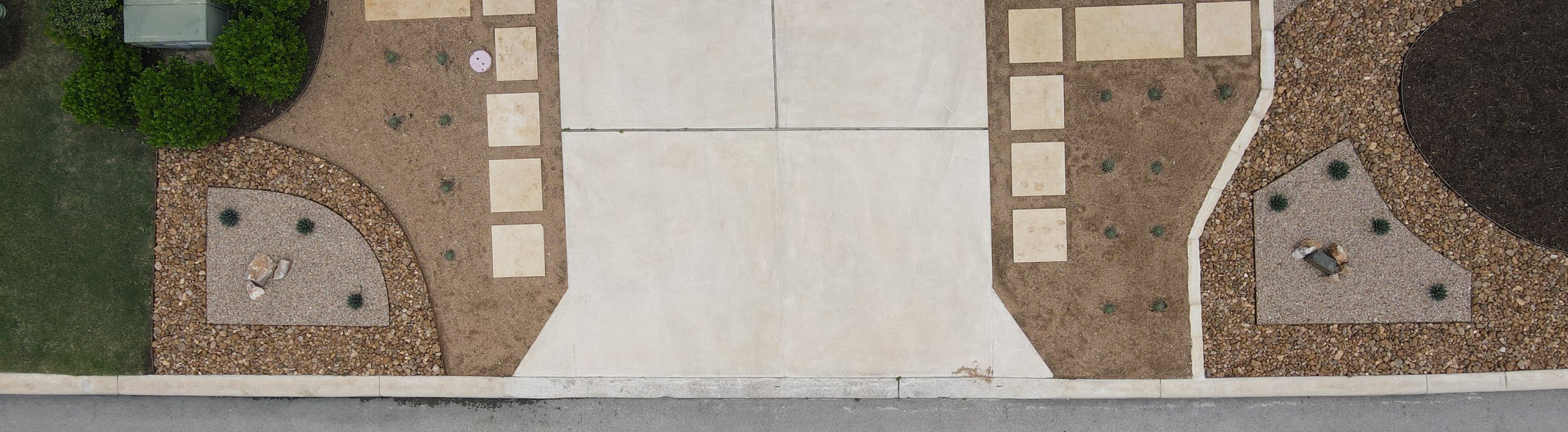
There are other budget moves too. Keep a sound slab and widen it with pavers or stone. Or put pavers on the apron and the first stretch near the house, with gravel beyond. On a Spicewood front yard, the concrete drive stayed and we framed both sides with cut limestone pavers set in decomposed granite. It reads like a new entry for a fraction of a full tear-out.
Why do Austin driveways crack, and can you fix one instead of replacing it?
Most cracked driveways we get called to look at failed underneath, not on top. The usual causes:
- Clay movement. The swell and shrink described above.
- A thin or missing base. Concrete poured right on clay, with little or no compacted stone under it.
- Water under the slab. Roof and street runoff that soaks the edge and softens the ground.
- Tree roots. A big oak next to the drive can lift a slab over the years.
Hairline cracks are common in concrete and usually cosmetic. A slab that has heaved, sunk, or broken into pieces that rock when you drive over them is usually done. If water caused the damage, fix the water first. We often add a French drain or regrade the edge so runoff goes around the driveway instead of under it. Skip that step and the new driveway fails the same way the old one did.
Do you need a permit to replace a driveway in Austin?
It depends on where the work is.
- On your property: For houses, the City of Austin lists "a sidewalk, driveway, or concrete flatwork that is not located in the public right-of-way" as work exempt from a building permit.
- The apron at the street: The apron, where the driveway meets the curb, is often in the public right-of-way. The city requires a Driveway/Sidewalk permit for new, modified, repaired, or demolished driveway approaches in the right-of-way. Pulling it takes a Right-of-Way Contractor License from the city, so ask every bidder how that piece gets handled.
- Impervious cover: A wider driveway adds impervious cover, and every lot has a cap set by its zoning and watershed. Lots in southwest Austin's Barton Springs Zone have much tighter limits. Check before you widen.
- Outside Austin: Round Rock, Cedar Park, Lakeway, Westlake Hills, and the counties each write their own rules.
- Your HOA: In master-planned neighborhoods, the HOA usually wants to approve a change in driveway material, color, or width. We prepare that submittal as part of the job.
How long does it take to replace a driveway in Austin?
- Concrete: Tear-out, forms, and the pour usually take a few days. Then the common rule of thumb is to keep cars off for about seven days, and longer for heavy trucks or an RV.
- Pavers or stone: About one to two weeks of work on site for a typical home driveway. You can drive on pavers as soon as the joints are filled and compacted.
- Permits and HOA review: Often the longest part. Start the paperwork early.
How do you compare driveway quotes in Austin?
Two driveway quotes can be thousands of dollars apart, and both can be honest, because "driveway" hides a dozen choices. Ask every bidder:
- How deep is the base, and what is it made of?
- Is tearing out and hauling off the old driveway included?
- For concrete: how thick is the slab, what reinforcement goes in it, and where do the control joints go?
- For pavers: how thick are the pavers, and what holds the edges in place?
- Which way does the driveway drain, and how is water kept away from the garage?
- Who handles the right-of-way permit for the apron, and who handles the HOA?
- What is the warranty if it settles?
When the base, drainage, and permit details match, the quotes usually move closer together. Our patio cost guide explains why base prep drives so much of the price on any hardscape job.
Ready to replace your driveway?
A driveway is the first thing people see, so we design it with the front walk, beds, and lighting as one entry instead of a slab on its own. We tie new drives into front walkways and, on acreage, into entry gates, all through our design-build process.
Call Thrive Landscape and Design at (737) 321-7812 or request a consultation. We will walk your driveway, check the grade and drainage, and give you an itemized number you can compare.