


You plant a new bed in October, and by Thanksgiving it looks like someone went over it with a string trimmer. If you live in West Austin or the Hill Country, you already know who did it. Deer move through yards in Lakeway, Steiner Ranch, Westlake Hills, and Dripping Springs most nights, and a bed of soft, freshly watered nursery plants is the best meal on the street.
There is no magic plant that fixes it. What works is the right plant list, a few smart barriers, and good timing. Here is how we plan and handle planting installation on Hill Country lots, and what we have learned from the beds that did not make it.
Is any plant really deer-proof in Austin?
No. The Lady Bird Johnson Wildflower Center, right here in Austin, keeps the go-to deer-resistant native plant list for our region, and it says it plainly: few plants are completely deer resistant. How much deer eat depends on how many deer live nearby, on drought, and on the plant itself. The City of Lakeway tells its residents the same thing: no plant is 100% deer proof.
What you can do is stack the odds. Deer tend to skip plants with:
- Strong-smelling, aromatic leaves
- Tough, leathery leaves
- Hairy or fuzzy leaves
- Prickly or spiny leaves
- Milky sap
A Texas Parks and Wildlife (TPWD) guide adds a detail most people miss: how tasty a plant is to deer depends partly on its health, which watering and fertilizer change. Wildlife research points the same way: well-fertilized plants grow more protein-rich, tender leaves, and deer prefer them. That is one reason a fresh, well-fed bed straight from the nursery gets hit so hard.
Which deer-resistant shrubs and evergreens hold up in Central Texas?
Shrubs are the backbone of a deer-smart yard, because they hold the shape of the design all year. These are the natives we install most, and each one is rated "High" for deer resistance in the Wildflower Center's plant database:
- Texas sage (cenizo). Silver-gray evergreen leaves and purple blooms after a rain. Handles full sun and rocky ground.
- Texas mountain laurel. Glossy, leathery evergreen leaves and grape-scented purple flowers in early spring. Its bright red seeds are poisonous, so we keep it away from play areas.
- Agarita. Spiny, holly-like evergreen leaves. A good living barrier along a property line.
- Flame acanthus. Orange tube-shaped flowers that hummingbirds love from summer into fall.
One honest caution: yaupon holly is a popular hedge plant, but the Wildflower Center rates it only "Moderate." On lots with heavy deer traffic, we cage young yaupons or plant them inside a fence. Our tree and shrub planting crews make those calls lot by lot. For how these same plants handle heat and drought, see our guide to native plants for the Central Texas heat.
What deer-resistant flowers bloom in full Texas sun?
Many Hill Country yards are full sun and thin, rocky soil, and that works in your favor. Plenty of the best sun bloomers here are also plants deer pass over:
- Autumn sage (Salvia greggii). Aromatic leaves and blooms from spring through fall. Rated "High."
- Blackfoot daisy. Low white mounds that love heat and rock. Rated "High."
- Damianita. Needle-like, strongly scented leaves and yellow flowers. It grows wild on limestone slopes.
- Texas lantana and mealy blue sage. Both are on the Wildflower Center's deer-resistant list, and both bloom from spring into fall.
- Lindheimer muhly and Gulf muhly. Native grasses that add movement and fall color. Lindheimer muhly is rated "High," and Gulf muhly is on the deer list.
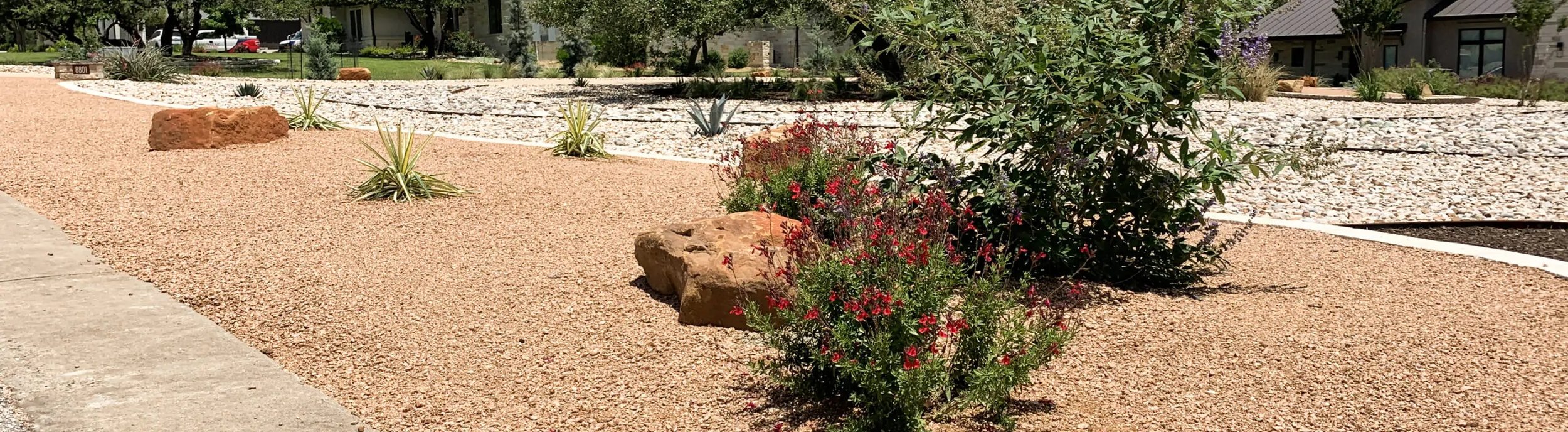
On an open Dripping Springs front yard, we built the beds around salvia, agave, yucca, and ornamental grasses set in gravel with sandstone boulders. It looked finished the day we left, and it gives the deer very little worth coming back for.
What can you plant under oaks and in shade that deer leave alone?
Shade is harder. Many shade plants are soft and leafy, which is exactly what deer want. A few natives rated "High" by the Wildflower Center do well under live oaks:
- Inland sea oats. A native grass for part shade to full shade. It spreads, so we give it a firm edge.
- Texas sedge. A low, grassy groundcover for dry to moist shade, and a good stand-in for lawn where grass won't grow.
- Heartleaf skullcap. Blue-violet flowers for part shade to full shade.
Turk's cap is a shade favorite, but it is rated only "Moderate," so expect some nibbling in dry spells. In shaded beds like the ones we built in River Place, we pair these plants with decomposed granite paths and stone. That way the bed still looks designed even when the deer take a bite. Our garden bed installation work starts with the soil and edging, so the plants get a fair start.
How tall does a fence need to be to keep deer out?
Eight feet. TPWD's guide to local deer control calls game fences at least 8 feet tall the only fully reliable way to keep deer out. A 6 foot fence slows deer down, but it will not reliably stop them.
That does not mean you have to wall in the whole lot. On most Hill Country properties, we:
- Plant the front yard and open ground with deer-resistant plants only
- Fence a smaller backyard or garden area for roses, vegetables, and softer perennials
- Use metal or wire panels in a custom fence where you want to keep the view
If your HOA caps fence height, width can help. The same TPWD guide notes that deer have poor depth perception and tend to avoid jumping fences that are wide or angled, even when they are not very tall. Austin's height and permit rules are covered in our fence cost guide, and in HOA neighborhoods the HOA usually has the final say on height and style, so we check before we build.
Do repellents, coffee grounds, or soap actually keep deer away?
Not for long. TPWD's guide says commercial repellents have had limited success. They work best where deer numbers are low and when you reapply often. Lakeway's own advice is to spray every two weeks and after every rain.
Home remedies do worse. TPWD says human hair and soap are not reliable repellents, and that deer get used to noisemakers and motion-activated lights in a short time. We have not seen coffee grounds hold off a hungry herd either.
A repellent is a fair short-term patch for a new bed. It is not a plan. The plan is the right plants, a fence where you truly need one, and protection for anything young.
How do you protect new plants and young trees from deer?
The first year is when you lose plants. Here is how we install so new plantings make it:
- Cage young trees. Bucks rub their antlers on small trunks and can strip the bark all the way around, which kills the tree. A Texas A&M AgriLife Extension guide from Bexar County says the only protection its author found effective is a cage of fencing or concrete reinforcing mesh. We leave cages on until the trunk can take it.
- Wrap tender shrubs. Temporary wire mesh around new plantings, which Lakeway also recommends, buys a season for roots to grow.
- Water to establish, not to push growth. Soft, well-fed new growth is what deer prefer, so we skip heavy fertilizer at planting. We also set up drip irrigation to put water at each plant's roots on a steady schedule.
- Plant in fall. The Travis County AgriLife Extension office says the best time to plant is fall, winter, or very early spring. Plants set out now have the cool months to grow roots before next summer.
There is one catch. Fall is also breeding season for Hill Country deer, when bucks are rubbing and marking. So when we plant trees in October and November, the cages go on the same day.
How does deer pressure change the plan in Lakeway, Westlake Hills, and Dripping Springs?
Every neighborhood out west has deer, but each lot asks for something different.
- Lakeway. Feeding deer is illegal in Lakeway, a Class C misdemeanor with a fine of up to $500. TPWD explains why that matters: feeding packs deer into small areas and makes them less afraid of people. Wherever neighbors feed, plan for heavier browsing than any plant list suggests.
- Westlake Hills. Many lots here are steep, with thin soil over limestone. Plants that like rocky, alkaline ground, such as Texas mountain laurel and damianita, do double duty.
- Steiner Ranch and River Place. Constant deer traffic, lots of oak shade, and HOA rules on fences. We lean on the shade list above and fence only where the HOA allows it.
- Dripping Springs. Many lots are larger, often with open, unfenced front yards. We plant the open ground with tough natives in gravel and save the softer plants for a fenced area near the house.
Ready to plant a yard the deer walk past?
We design and install deer-resistant landscapes across Austin and the Hill Country, from the landscape design and plant list to the beds, drip irrigation, cages for new trees, and fencing where it makes sense. We don't offer mowing or weekly maintenance, and a deer-smart design is meant to need very little of it.
Fall is the best time of year to get plants in the ground. Call Thrive Landscape and Design at (737) 321-7812 or schedule a design consultation, and we will walk your lot, look at what the deer are already eating, and build a plan that holds up.