

Call three fence companies in Austin and you can get three quotes that are thousands of dollars apart, for what sounds like the same fence. We hear it from homeowners every week. The fence is leaning after a spring storm, the dog found the gap, or the neighbor's chain link has been an eyesore long enough. Then the quotes come in and nothing lines up.
We build fences across Austin and the Hill Country as part of our design and build work, so we know exactly where the money goes. This guide gives you real price ranges, the height and permit rules inside Austin city limits, and how to read a fence quote so you can compare companies fairly.
How much does a new fence cost in Austin?
For most Austin homes, a new 6 foot wood privacy fence runs about $25 to $55 per linear foot installed. Where you land in that range depends on the wood, the posts, and the style. Here is what we typically see:
- Pressure treated pine privacy fence: about $25 to $40 per foot
- Cedar privacy fence: about $35 to $55 per foot
- Board on board cedar with a cap rail: about $45 to $70 per foot
- Ornamental metal (aluminum or steel): about $60 to $110 per foot
- Upgrading to steel posts: add roughly $4 to $8 per foot
A typical Austin backyard needs somewhere between 120 and 180 feet of fence. So if you have been searching "how much should a 200 foot fence cost," the honest answer here is roughly $5,000 to $8,000 in pine and $7,000 to $11,000 in cedar, before gates and extras. A standard walk gate adds a few hundred dollars. An automatic driveway gate is its own project and usually starts around $6,000.
Treat these as planning numbers, not a bid. Slopes, tree roots, old fence tear-out, and rocky ground all move the price, and in this town the rock moves it more often than anything else.
Cedar, pine, or metal: which fence material holds up in Central Texas?
Cedar is the default for a reason. It handles our heat well, it resists rot and insects naturally, and it stays straighter than pine as it dries. Pressure treated pine is the budget pick. It works, but it is wetter wood when installed, and our summer sun pulls moisture out fast, which is why pine pickets twist and cup more often. We walked through how brutal this sun is on lumber in our wood versus composite deck guide, and everything there applies to fences too.
Whatever picket you choose, spend the extra money on galvanized steel posts. Wood posts rot at the ground line, and that is where almost every leaning fence we replace has failed. Steel posts set in concrete will usually outlive two rounds of pickets.
Ornamental aluminum and steel fencing makes sense where you do not want to block the view: pool enclosures, front yards, and Hill Country lots that look out over the trees. On a ranch style property outside Smithville we ran black iron fencing and a stone column entry gate along the whole road frontage, and it frames the land instead of hiding it.
How tall can a fence be in Austin? Is 8 feet too high?
Inside Austin city limits, a solid fence along a property line can be up to 6 feet tall, measured from the natural grade. The city allows some room beyond that:
- Up to 7 feet where the ground slopes at least a foot along that section of fence
- Up to 8 feet if the fence sits on or inside the building setback lines, not right on the property line
- Up to 8 feet where your lot backs up to commercial or industrial property
Anything taller than 7 feet at any point needs a permit. The full rules are on the City of Austin fencing regulations page.
The 8 foot question usually comes from deer country, and it is the right question. A 6 foot fence is a speed bump for Hill Country deer. In neighborhoods like Steiner Ranch, where deer pressure is constant, an 8 foot privacy fence set inside the setback line is often the practical answer. Outside Austin city limits the county rules differ, and your HOA usually has the final say on height and style, so we check both before we build.
Do you need a permit to build a fence in Austin?
Most residential fences do not need a permit. Per the city's fencing regulations, you need one when:
- Any part of the fence is taller than 7 feet
- The fence is in a floodplain, at any height
- A residential fence along the public right of way exceeds 6 feet, which also requires a Board of Adjustment variance
Corner lots have one more wrinkle: the city wants sight lines at the intersection kept clear, so fence placement gets coordinated with the transportation department.
The approval most Austin homeowners actually need is not from the city. It is from the HOA. Communities like Circle C and Shady Hollow spell out fence height, stain color, and picket style, and some require the finished side to face out. The process works the same way we described for pergolas and patio covers: submit the drawings first, build second. We handle that paperwork on our projects.
Who pays for a fence between neighbors, and who gets the good side?
Texas has no state law that forces a neighbor to split the cost of a fence on the property line. Unless your neighbor agrees to share, the person who wants the fence pays for it. The Texas State Law Library's neighbor law guide spells that out. As for the "good side," no Texas statute we know of settles it. When that rule exists, it comes from your HOA, and many Austin HOAs do require the finished side to face out.
In practice, most neighbors do split a shared fence, and we recommend getting that agreement in writing before the first post goes in. If the "good side" debate is stalling things, a board on board or cap and trim custom fence looks finished from both sides and ends the argument.
Why do Austin fence quotes vary so much?
Two quotes for "150 feet of 6 foot cedar privacy fence" can differ by $3,000 and both be honest. The difference lives in the line items:
- Posts: steel or wood, how deep, and how much concrete
- Digging: parts of Austin sit on limestone and caliche, and rock drilling costs more than digging loam
- Picket grade: number one cedar versus knotty, thinner stock
- Fasteners: ring shank nails and screws hold through our wind and heat cycles better than smooth nails
- Trim: cap rails and kickboards add material but add years
- Tear-out: hauling off the old fence is real labor that some quotes quietly skip
- Gates: hardware quality is where cheap gates fail first
Before you try to negotiate a number down, make the quotes match line for line. A low bid with wood posts, thin pickets, and no haul-off is not the same product as a higher bid with steel posts and number one cedar. Big box store fence installs run through subcontractors with a markup in the middle, so you are often paying retail for the crew a local builder hires directly.
When is the best time of year to build a fence in Austin?
Any month works here. The ground does not freeze, so there is no off season the way there is up north. A few practical notes from our schedule:
- Fall and winter usually mean faster scheduling and easier weather on the crew
- Spring is storm season, and every fence that blew over gets quoted the same week, so lead times stretch
- Summer builds are fine, but let new wood dry several weeks before staining it
If a storm just flattened your fence and every company is booked, that is the spring rush at work. Calling in the calmer months gets you better scheduling and sometimes better pricing.
How long will a wood fence last in the Texas sun?
In our experience, a cedar fence in Austin gives you 15 to 20 years, and pine closer to 10 to 15, if the fence is built and cared for properly. Three things stretch that lifespan:
- Steel posts. The pickets should wear out before the structure does.
- Stain or sealer every 2 to 3 years. Ultraviolet light, not rain, is what eats fences here.
- Keep sprinklers off the fence. Constant irrigation overspray rots the bottom of pickets years early. Aim heads away from the fence line, or have us adjust them.
A fence that gets none of that care can look gray and tired in five years. The wood does not fail evenly either, so budget for the occasional picket swap after big wind events.
Ready to build a fence that fits the whole yard?
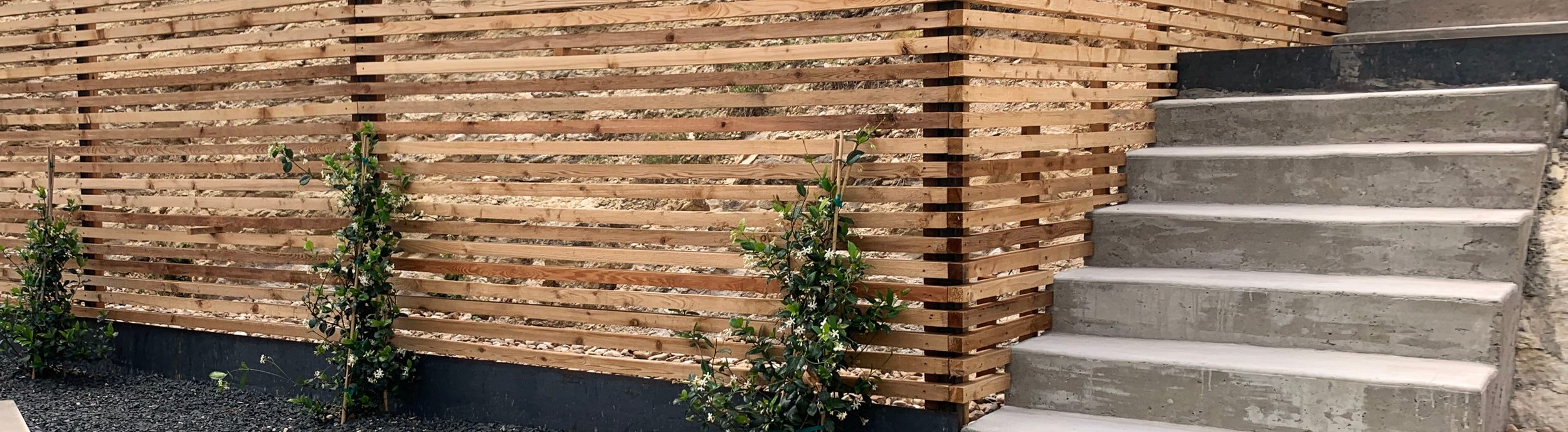
A fence is the frame around everything else you love outside. We design and build wood fences, metal fencing, and gates as part of complete landscapes, like the horizontal slat cedar fence we built into a terraced yard in Westlake Hills. One crew, one plan, and a fence that matches the landscape instead of fighting it.
If your fence is on its last season, call Thrive Landscape and Design at (737) 321-7812 or reach out online for a design consultation. We will walk the property line with you and give you a quote you can actually compare.