

By the middle of August, a lot of Austin lawns have already lost. The St. Augustine in the front is thin and gray. The strip along the driveway is dirt. The dog has worn a track to the back gate. So the homeowner starts pricing two things at once: a pallet of new sod, or a synthetic lawn that never needs another drop of water.
We install both as part of our design and build work, so we do not have a dog in this fight. We put in artificial turf when it is the right call and we lay sod when it is not. Here is how the two compare in Central Texas.
Should you install artificial turf or new sod in an Austin yard?
Start with one question: why did the last lawn die?
If the answer is heat, water restrictions, or a budget you did not want to spend on irrigation, new sod will die the same way. If the answer is shade, dog traffic, or a spot that never drains, that is a site problem, and it will chew up synthetic turf too.
How we decide:
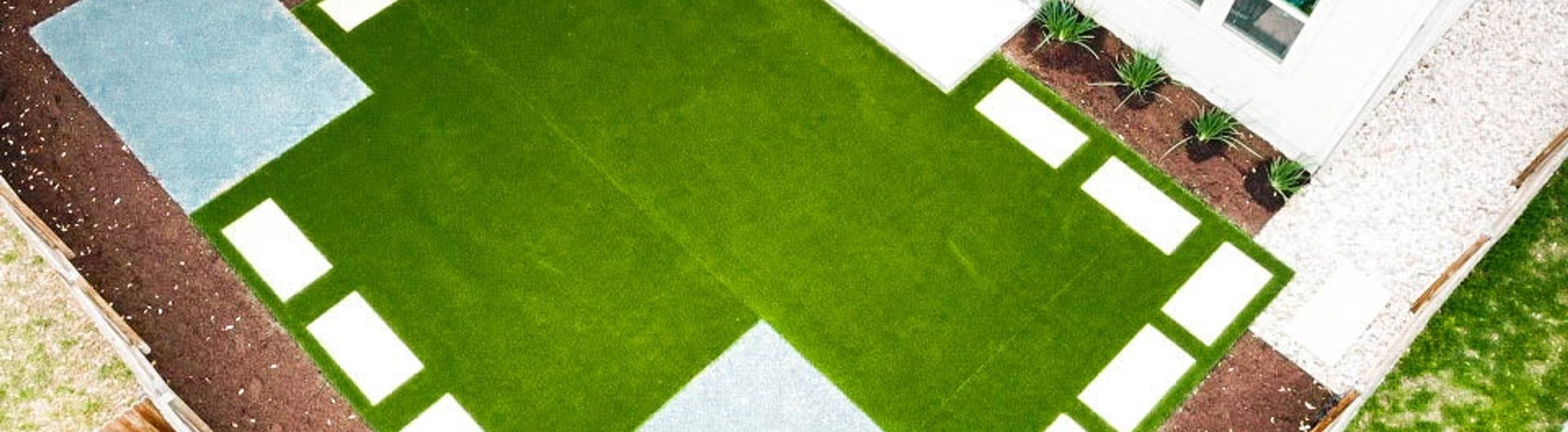
- Turf makes sense for small, hard-used areas. Dog runs, side yards, a play space between a patio and a fence, a courtyard with no mower access.
- Sod makes sense for larger open areas, yards with mature shade, and anyone who wants the yard cool and soft underfoot in June.
- Neither makes sense on a big slope you never walk on. That is a planting bed waiting to happen, and it costs less than both.
The mistake we get called to fix is a homeowner who covered 2,000 square feet of full sun backyard in synthetic turf and now cannot use it from noon to six.
How much does artificial turf cost in Austin?
For a real install, expect roughly $12 to $20 per square foot in the Austin market. An 800 square foot backyard panel lands somewhere around $10,000 to $16,000.
That number surprises people, so here is where it goes:
- Excavating and hauling off 3 to 4 inches of existing soil
- Decomposed granite or crushed base, laid in lifts and compacted
- Weed barrier, plus edging or a stone border to lock the perimeter
- The turf itself, which varies by pile height, backing, and warranty
- Infill, seaming, and nailing every 4 to 6 inches around the edges
When a quote comes in at $7 to $9, one of those steps got skipped, and it is almost always base depth. On our clay, a thin base is why cheap turf goes lumpy and holds puddles by year three.
How much does new sod cost, and which grass is best for Austin?
Sod is far cheaper up front. Installed, with the dead lawn removed and the soil prepped, most Austin jobs run about $1.25 to $2.75 per square foot. That same 800 square feet is closer to $1,000 to $2,200.
Which grass depends almost entirely on sun. Texas A&M AgriLife's turfgrass selection guide rates the warm season grasses side by side:
St. Augustine
The most shade tolerant warm season grass we can grow here, which is why it is everywhere in older Austin neighborhoods under live oaks. AgriLife rates its drought tolerance as good and its traffic tolerance as low, with high disease potential. Great under trees, poor for dogs.
Zoysia
Shade tolerance moderate to high, drought tolerance very good, traffic tolerance moderate to high. It is the best all around choice for a lot of Austin yards and it needs mowing less often. It also costs more and fills in slowly.
Bermuda
Drought tolerance very good to excellent and the best traffic tolerance of the group, but shade tolerance is very low to low. Perfect for a wide open, full sun yard in Round Rock or Pflugerville. It will thin out to nothing under a canopy.
Buffalograss
Uses the least water of the group, but AgriLife notes it suits areas getting 25 inches of rain or less a year and gets invaded by weeds where rainfall or watering is heavier. Austin averages well above that, so we rarely use it as a whole back lawn.
Does artificial turf get too hot for a Central Texas backyard?
Yes, and this is the part the turf salesman tends to skim past.
Penn State's Center for Sports Surface Research summarizes research on synthetic surface temperature showing surface temperatures up to 50 degrees hotter than natural grass. Put that on top of a 100 degree Austin afternoon and you have a surface nobody is walking on barefoot.
The fixes are all design decisions rather than product upgrades. Put turf where it gets afternoon shade instead of west facing sun, keep the panels small, break them up with patio or stepping stones, and build shade over them. A pergola changes the surface temperature more than any premium turf will.
Grass does not have this problem. A living lawn cools itself, which is the single best argument for sod in a yard where people actually sit.
What are the real downsides of artificial turf?
Beyond heat, here is the full list:
- It has an end date. A good system lasts around 15 to 20 years, then the whole thing gets torn out and replaced. Sod gets patched.
- Dog urine needs rinsing. It does not break down the way it does in soil.
- Static and matting show up in high traffic lanes.
- It is plastic. It supports no soil life, no pollinators, and nothing else in the yard.
None of that makes it a bad product. It makes it a product with a job. We use it for the 300 square feet nothing will grow on, not for the whole yard.
Which is better if you have dogs?
For dogs, turf usually wins, and it is the most common reason our clients choose it. Dogs kill real grass in predictable places: the fence line patrol route, the shaded corner, the spot by the back door. Turf does not turn to mud in February and does not yellow.
The catch is drainage. We build pet installs with a more open base and a permeable backing so urine moves through instead of sitting. If a turf quote for a dog yard does not name the backing or the infill, keep shopping.
Does rain drain through artificial turf on Austin clay?
Rain drains through the turf. The question is what happens once it hits the clay underneath.
This is the failure we see most on fix-it calls. Austin sits on heavy clay and shallow caliche that already sheds water, and a synthetic lawn does not fix a grade problem. If water sat there before, it will sit there after, just under the turf where you cannot see it until it smells.
So on almost every turf project we look at the whole water path first. That usually means yard grading before anything goes down, and sometimes a French drain tied out to daylight. It also means checking impervious cover, since Austin has counted synthetic turf against impervious cover limits unless the installer documents a permeable system. On a lot near its limit, confirm that with the city first.
Can your HOA stop you from installing artificial turf in Texas?
Probably yes, and a lot of turf marketing gets this wrong.
Texas Property Code Chapter 202 stops an association from banning drought resistant landscaping, rain barrels, efficient irrigation, and water conserving natural turf. That word matters. The protection covers low water real grass and xeric landscaping, not plastic. Your HOA in Circle C or Steiner Ranch can still say no to synthetic turf, or allow it only in a back yard.
One thing did change in your favor. A 2025 law added Section 202.008, which stops an association from fining you for brown or discolored grass, or for failing to keep turf green, while your property is under a residential watering restriction and for 60 days after it lifts.
Either way, submit a plan before you buy anything. Associations can review type and appearance.
Will Austin Water help pay for either one?
For sod and xeric conversions, yes. For synthetic turf, no.
Austin Water's WaterWise Landscape Rebate pays up to $3,000 for converting irrigated lawn to native and adapted beds, permeable hardscape, or rock gardens. To qualify, at least 75% of the conversion area has to have healthy turf grass to begin with, since the whole point is the water you stop using. The FAQ is explicit that artificial turf is not eligible.
There are other rebates worth stacking on the rebates page, including up to $1,000 for an irrigation upgrade. If part of your yard is going to beds anyway, that combination often pays for a meaningful chunk of the project. We cover the bed side of this in our guide to xeriscaping in Austin and the surface side in our post on decomposed granite and water-wise hardscape.
When can you actually install turf or sod in Austin right now?
Turf goes down any month of the year. It does not care.
Sod has a calendar, and right now it is tight. Warm season grass needs warm soil and steady water to root, which is why AgriLife points at spring once soil temperatures are up. Late summer and early fall can work here, but only if you keep it wet while it knits in.
That is the real constraint. Austin is under Conservation Stage restrictions, and Austin Water is one of the only utilities in Texas with permanent year round conservation rules. Under the current watering schedule, automatic and manual irrigation systems get one day a week, midnight to 10 a.m. or 7 p.m. to midnight. Hose end sprinklers and drip get two days. Hand watering with a held hose is allowed anytime.
New sod on one irrigation day a week is a gamble. Before we sod anything we check whether the system can actually deliver, and we often convert beds to drip irrigation, which gets the extra day. If your zones are already limping, our post on sprinkler repair costs covers what that work runs.
Ready to figure out which one your yard needs?
Most yards we design end up with some of both. A turf panel where the dogs run, real grass where people sit, and beds of drought tolerant planting across everything nobody walks on. That mix costs less than an all turf yard and holds up better than an all sod one.
If you are staring at a dead lawn in Austin, Round Rock, Steiner Ranch, or Westlake Hills, let us walk it with you. We will look at sun, grade, drainage, and how you use the space, then put a real number on both options. Start with a backyard design consult and call us at (737) 321-7812.