

Every year at the end of August the phone calls change. All summer people ask us for shade. Then the first evening drops under 80 degrees, somebody sits outside after dinner for the first time since May, and the question becomes fire. It is the most reliable seasonal shift we see, and it is why fall is when most of the fire features we build get designed.
The choice almost always comes down to a fire pit or an outdoor fireplace. They photograph similarly. They do not behave the same way, they do not sit on a lot the same way, and in Central Texas they do not run into the same rules. Here is how we decide between them.
Is an outdoor fireplace better than a fire pit for an Austin backyard?
Neither is better. They solve different problems, and the right answer usually comes from the shape of your yard rather than your taste.
A fire pit is low and open. People sit all the way around it, everyone can see everyone, and it keeps sightlines across the yard intact. On a Westlake Hills or Lakeway lot where the whole point is the view down the hill, that matters more than anything else. A four foot tall firebox parked in the middle of that view is a permanent mistake.
An outdoor fireplace is a vertical piece of architecture. It gives you a wall, and a wall does three things a pit cannot:
- It anchors one end of a patio and makes the space feel like a room instead of a slab
- It blocks the wind, which is the actual reason a fireplace feels warmer
- It screens a view you do not want, like the neighbor's second story on a tighter East Austin lot
We lean toward a pit when the yard is the feature. We lean toward a fireplace when the yard needs edges.
Do outdoor fireplaces actually keep you warm here, or is that a northern idea?
Mostly it is a northern idea, and we will say that even though fireplaces are the bigger project.
A firebox throws heat in one direction and holds it against a mass of stone, so it genuinely warms a seating area better than an open pit does. But Austin gets a handful of nights cold enough for that to be the deciding factor. Most of our fire season is 45 to 65 degrees, and at those temperatures an open fire pit is plenty.
What a fireplace really buys you here is wind protection and architecture. Those are good reasons. "It will keep us warm in January" is not a strong one in this climate, and we would rather you hear that before you build.
Should you burn wood or run gas in Central Texas?
This is the decision that changes how often the thing gets used.
Wood gives you the smell, the sound, and the ritual. It also gives you smoke drifting into a neighbor's window on a small lot, ash to haul out, and, critically here, exposure to burn bans.
Gas lights with a switch. No smoke, no ash, no wood pile, no waiting. On a tight lot or for a client who wants the fire on for twenty minutes after dinner and then off, gas gets used ten times more often. The trade is that it never fully looks or smells like a wood fire, and it needs a licensed plumber and a permit.
For most of the high-design projects we build, gas wins on use and wood wins on romance. A fair number of our clients build a gas fireplace on the patio for the weeknights and keep a simple wood pit further out in the yard for the nights they want the real thing.
Can you legally have a fire pit in your backyard in Austin?
Yes, within rules that are stricter than most homeowners expect. Austin Fire's recreational fire guidance for single family homes sets out the requirements, and the ones that shape a design are these:
- The fire must be at least 25 feet from structures and other combustible materials
- Dry grass, leaves, and other combustibles have to be cleared for at least 10 feet around the fire area
- The fuel area cannot exceed 3 feet in diameter or 2 feet in height
- Only solid fuels are allowed
- It must be constantly attended by a competent adult, with a 4-A rated extinguisher or a garden hose ready
- Open burning is prohibited in the City of Austin
That 25 foot number is the one that kills designs. On a typical East Austin lot, 25 feet from the house and 25 feet from the fence and 25 feet from the garage does not leave much yard. We have had to move plenty of fire pits from where the client first pointed. It is worth measuring before anyone falls in love with a location.
Is there a burn ban in Travis County right now, and what can you still use?
Yes. As of August 11, 2026, outdoor burning is prohibited in Travis County. Bans come and go with drought conditions, so check the county before you plan an evening around a wood fire.
Here is the part people get wrong. The Fire Marshal's FAQ says open flame cooking can be done outdoors during a burn ban, but the flames must be completely enclosed in the cooking device. That language is about cooking devices. It is not a blanket exemption for a decorative gas fire bowl, and we would not tell you your gas feature is automatically fine during a ban. If that distinction matters to you, call the Fire Marshal's office and get the answer for your specific setup before you build.
What we can say plainly: a gas feature is far less likely to be sidelined by drought conditions than a wood one, and in a region that spends a good part of most years in some stage of drought, that is a real design argument.
Which materials actually hold up on a Hill Country lot?
Fire and Central Texas weather are hard on masonry, and the failures we get called to fix are almost always material or assembly problems rather than design problems.
What we build with
- Local limestone, including chopped block and Lueders, looks like it belongs here because it does. It weathers to something better than it started as.
- Firebrick liner in every firebox and pit interior. This is not optional. Ordinary stone and standard block spall and crack when they take direct flame, and once the liner is missing there is no good repair.
- Steel and weathering steel bowls for a modern Hill Country house, often dropped into a limestone or board formed concrete surround so the two materials play off each other.
- Stucco over block when the architecture is clean and modern and native stone would fight it.
What we get called to fix
- Thin veneer glued to a hollow or poorly built core, which cracks along the joints in a few seasons
- A pit with no drainage, which fills with water in a spring storm and then holds it against the masonry
- Caps set with the wrong mortar, which is the number one reason a two year old fireplace looks ten
Where should the fire feature sit on your property?
Siting is where the design is won, and there are four questions we work through on every lot.
Which way does the smoke go? Stand in the yard on a few different evenings and pay attention to which way the air actually moves. Put a wood pit upwind of your own covered patio, or of a neighbor's bedroom window, and you have built a smoke machine.
Does it block the view? On the hillside lots we work on in Westlake Hills and Lakeway, we keep fire low and downhill so the horizon stays open from the house.
Is this a wildfire aware neighborhood? In Steiner Ranch and River Place, where homes sit against greenbelt and heavy cedar, siting is a safety decision and not just an aesthetic one. Texas A&M Forest Service treats the first five feet around a house as the zone most vulnerable to embers and advises moving combustible material like mulch and firewood away from exterior walls. A fire feature belongs well outside that band, not tucked against the house.
Never under a canopy. We will not put an open fire under a live oak. The heat damages the tree and the tree is worth more than the fire pit.
Do you need a permit, and what will your HOA say?
The masonry itself often does not need a building permit. The gas does.
Gas piping is licensed plumbing work, and the City's permitting guidance states that any project with natural gas or propane requires a separate plumbing permit and City of Austin inspections. For propane specifically, Austin Fire notes that a permit is not required for non-commercial use at a single family residence, but the owner still has to provide location and exposure information to the fire department. Any builder who tells you gas is a no paperwork job is telling you something else about how they work.
On the HOA side, expect an architectural review submittal in Circle C, Steiner Ranch, and most Lakeway subdivisions for anything with real height. A tall fireplace and chimney usually triggers review. A low fire pit usually does not. Also watch impervious cover, because the patio you build around the fire counts toward your limit even though the fire feature is the thing you are excited about.
Is a smokeless fire pit or a gas insert worth building in?
Sometimes, and we will talk clients out of this one regularly.
Smokeless inserts do meaningfully cut smoke, and on a small lot with close neighbors that can be the difference between using the pit and hearing about it. Dropping a quality insert into a custom stone surround is a genuinely good build, and it looks nothing like a bare metal bowl sitting on a patio.
But if what you actually want is a portable smokeless unit on an existing patio, buy the portable unit. It works, it moves, and it does not need us. We would rather point you there than sell you masonry you did not need.
How should it connect to the rest of the yard?
A fire feature that sits by itself in the grass never gets used. The ones that get used every week are part of something.
- Size the patio for the seating, not the fire. Plan for the chairs pulled back, plus a walking lane behind them. Under sized patios are the most common regret we hear.
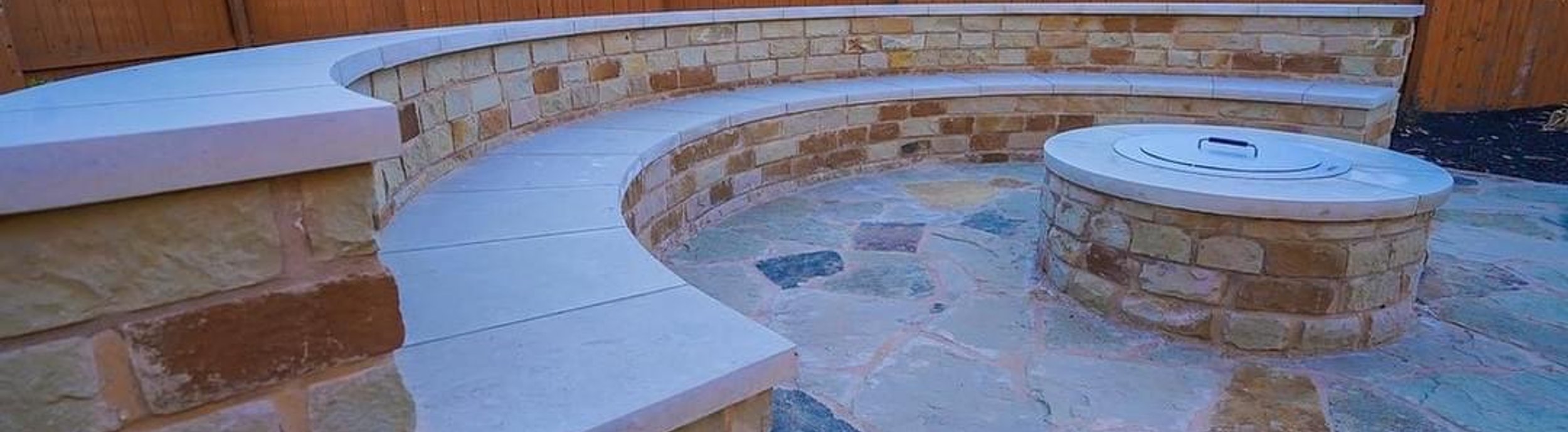
- Build seat walls. A low retaining or seat wall around part of the pit adds permanent seating and, on a sloped lot, does the grading work at the same time.
- Light the path to it. Nobody walks to the back of the yard in the dark. A few low voltage fixtures along the route are what make the space usable, which we get into in our guide to landscape lighting in Austin.
- Keep it near the kitchen, or give it its own. If the fire is 60 feet from the food, one of them goes unused. Sometimes the answer is an outdoor kitchen closer to the fire.
This is the part that turns a fire pit into an outdoor living space, and it is the same thinking behind our approach to designing a backyard for Texas seasons.
Ready to build it?
If you are weighing a fire pit against a fireplace, the fastest way through it is to walk the lot with someone who has to live with the answer. We will look at your wind, your views, your setbacks, and your soil, and tell you honestly which one your yard wants, including when the answer is the simpler one.
We design and build fire features across Austin and the Hill Country as part of our backyard design work. Get in touch to set up a design consultation.