
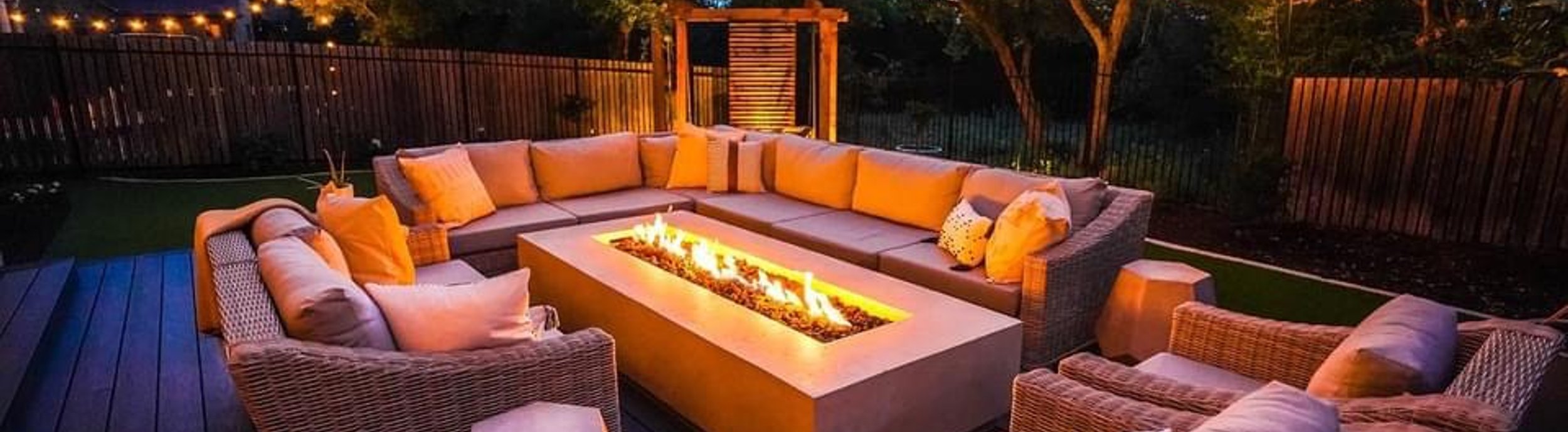

Here is the Austin version of this problem. You spend real money on a patio, a fire pit, and a stand of live oaks. Then September arrives, the sun drops before you have finished dinner, and the whole thing goes black. For most of the year, the hours you actually want to be outside in Central Texas are the hours after dark. That is the entire argument for landscape lighting, and it is why we get more calls about it in the fall than in the spring.
Here is what it costs here, what drives the number, and where the cheap version falls apart.
How much does landscape lighting cost in Austin?
Professional systems get priced two ways, and you should ask which one you are being quoted.
Most reputable installers price per fixture, installed. That number bundles the fixture, the lamp, the wire, the labor, and a share of the transformer. Around Austin, a quality brass or copper fixture installed on a properly designed system generally lands in the low-to-mid hundreds of dollars each. Big-box aluminum and plastic fixtures cost a fraction of that on the shelf, which is exactly why the shelf price is a bad comparison.
A useful way to think about the whole project:
- A front entry and a few tree uplights is the entry point, usually eight to twelve fixtures
- A full front and back package on a typical Austin lot runs two to four times that, because you add path runs, a second transformer, and longer wire pulls
- A large Hill Country property with terraced walls, a pool, long driveways, and heritage oaks is a serious line item, comparable to a mid-sized hardscape project
The other pricing model is a flat design-and-build number tied to a plan. That is how we prefer to work, because the fixture count should come out of the lighting design, not the other way around.
What are you actually paying for per fixture?
This is the question that separates the quotes. Two bids can both say "18 fixtures" and be different products entirely.
What sits inside a premium number:
- Solid brass or copper housings. They patina instead of corroding. Powder-coated aluminum and composite fixtures chalk, pit, and fail faster, and in our heat they fail faster still.
- Buried wire, not surface-laid cable. Direct-burial low voltage cable belongs in a trench, not stapled to a bed edge or hidden under mulch where a shovel finds it.
- Correctly sized wire. Long runs on undersized wire lose voltage, and the fixtures at the end of the run go dim and yellow. Heavier gauge on long runs costs more up front and is the difference between a system that looks even and one that does not.
- A transformer with headroom. Sizing a transformer to the exact connected load leaves nothing for the future. We size for what the yard will need in five years.
- Real lamps. Beam angle, lumen output, and color temperature get chosen per fixture. A path light and a 30-foot oak uplight are not the same lamp.
- A warranty that means something. Ask specifically what is covered, for how long, and whether labor is included.
Are solar stake lights or a big-box kit good enough?
For a temporary bed edge, sure. For a house you plan to keep, no, and we say that from the number of them we pull out.
Solar stake lights charge in the same Texas sun that cooks their batteries. Output is dim by design, the color is usually a cold blue-white that makes limestone look gray, and the run time collapses after a couple of seasons. Under the live oak canopy in Westlake Hills or Bee Cave, they barely charge at all.
Box-store kits fail differently. The fixtures are fine for a year or two. What fails is everything around them: a transformer sized with no margin, thin wire on runs that are too long, and connectors never meant to sit in wet clay. The lights near the transformer stay bright, the far ones dim out, and eventually a corroded connection takes a whole leg dark.
The honest math is that a cheap system replaced twice costs more than a good system installed once, and you spent both of those years looking at a mediocre yard.
What is low voltage lighting, and why does it matter here?
Nearly all residential landscape lighting is low voltage. A transformer steps 120-volt household power down to roughly 12 volts, and everything past that transformer runs at the lower voltage.
That matters for practical reasons:
- It is far safer around kids, dogs, irrigation, and anyone digging in a bed later
- Under the National Electrical Code, circuits of 30 volts or less have a much shallower minimum cover requirement than line-voltage wiring, which means less destructive trenching through established beds and root zones
- Fixtures can be moved and beams re-aimed as plants grow in, without an electrician
The one part that is genuine electrical work is the supply side. If your yard needs a new exterior GFCI receptacle or a dedicated circuit to feed the transformer, that is permitted electrical work in Austin and should be done by a licensed electrician. Replacing an existing fixture or receptacle is generally exempt. Confirm the current rules with Austin Development Services before anyone starts.
What kinds of fixtures does an Austin yard actually need?
A good plan uses a small number of techniques deliberately, not one fixture type everywhere.
Uplighting and tree lighting
Central Texas gave you the best material for this. A heritage live oak lit from two or three angles is the single highest-impact thing we install. Fixtures go at grade or on stakes, never lag-bolted into the trunk, and they get re-aimed as the canopy fills.
Path and step lighting
Path lighting is where most DIY jobs go wrong. Runway rows of identical lamps every six feet look like an airport. Spacing should be uneven and tied to the walk, and on the stone steps and terraces common on hillside lots, recessed step lights do more than stake lights ever will.
Wall washing and accents
Accent lighting on limestone, stucco, cedar privacy screens, and retaining walls is what makes a yard read as designed rather than lit. Grazing a rough limestone wall at a shallow angle brings out texture that disappears under flat light.
Structures and gathering space
Down-lighting from a pergola or into a patio is what extends the usable hours. We covered the broader version of this in our guide to building outdoor living space for Texas summers.
Security
Security lighting works through even coverage and eliminated hiding spots, not through one glaring floodlight that blinds you and annoys the neighbors.
How do Austin soil, heat, and trees change the install?
More than people expect, and this is where local crews earn the difference.
- Caliche and limestone. West of town, "trenching" often means chipping. Runs get routed around rock shelves, and that routing has to be planned, not improvised.
- Blackland clay. East of I-35 the soil swells and shrinks with the season. Clay heaves fixtures out of plumb and stresses buried connections, so we set fixtures with that movement in mind and use waterproof connections rather than twist caps in a bag.
- Heat on the fixture. LED life ratings assume a design operating temperature. Run a driver hotter than it was designed for and the rated hours are optimistic. Housings that shed heat well, and fixtures that are not buried in mulch, last meaningfully longer in our summers.
- Trees. Austin protects trees 19 inches in diameter and larger, with heritage protection at 24 inches in listed species. Trenching inside a critical root zone can require review by the City Arborist, so tree lighting near a big oak gets hand-dug or routed around.
- Growth. Plants in zones 8b to 9a fill in fast after a wet spring. A fixture aimed perfectly in March can be buried in foliage by June, which is why aiming visits matter.
- Irrigation. Lighting and irrigation share the same trenches and the same root zones. Coordinating them once beats cutting a line later.
Do dark sky rules apply to residential lighting out here?
In parts of the region, yes, and even where they do not, the guidance makes for better lighting.
Dripping Springs was designated a Dark Sky Community in 2014, the first in Texas, and residents inside the city limits are subject to its outdoor lighting ordinance. If you are building in Dripping Springs or Driftwood, check the current ordinance before selecting fixtures.
Everywhere else, DarkSky International's five principles are simply good design: light only where it is useful, shield and aim it downward, keep levels low, use timers and controls, and favor warmer color. Their approved-luminaire guidelines cap color temperature at a nominal 3000K. We stay at or below that anyway, because warm light flatters limestone, cedar, and native planting, while cool white makes a Hill Country yard look like a parking lot.
Neighborhoods with active architectural review, including Circle C and Shady Hollow, may also have their own standards. Those reviews go easier with a drawn plan.
How do you choose an installer without getting burned?
Ask five questions and the field sorts itself quickly:
- What fixture material and brand, and can I see one in hand?
- Is the wire buried, at what depth, and what gauge on the long runs?
- What size transformer, and what percentage of its capacity will my system use?
- What exactly does the warranty cover, and does it include labor?
- Will you come back to re-aim as the plants grow in?
Anyone who cannot answer the transformer question is selling fixtures, not a system. As a design-build firm, we draw lighting into the plan alongside grading, hardscape, and planting, which is why our installation crews are not guessing at conduit locations after the patio is poured. If you are still early and weighing quotes, our post on what landscape design costs in Austin covers how the plan comes first.
Ready to see your yard after dark?
Lighting is the smallest line item that changes how much you use everything else you built. If your patio, pool, or Hill Country backyard goes unused after sunset, that is a fixable problem.
Contact Thrive Landscape and Design to walk your property in Austin, Steiner Ranch, Round Rock, or anywhere across the Hill Country, and we will put a lighting plan together that is built to last.