

Most walkway calls we get in Austin start with one of three problems. The builder-grade concrete walk to the front door has cracked and lifted on the clay. The stepping stones in the lawn have sunk and vanished under the grass. Or there is no path at all, just a muddy track down the side yard that turns to soup after every storm.
We design and build walkways across Austin and the Hill Country in flagstone, pavers, concrete, and stepping stones. Here are planning prices, a worked example, and the local things that move the number. Treat every figure as a planning range, not a quote.
How much does a walkway cost in Austin?
Walkways use the same installed rates as our patios, because the work under the surface is the same. Most land in these ranges, including base:
- Stabilized decomposed granite (DG) or gravel with steel edging: about $6 to $12 per square foot
- Plain broom-finish concrete: about $8 to $16 per square foot
- Stamped or colored concrete: about $14 to $26 per square foot
- Concrete pavers on a compacted base: about $16 to $32 per square foot
- Dry-laid flagstone with gravel joints: about $18 to $35 per square foot
- Flagstone mortared onto a concrete slab: about $30 to $50 per square foot
- Flagstone stepping stones set in gravel or DG: about $30 to $70 per linear foot of path
A 3-foot-wide side-yard path that runs 40 feet is 120 square feet. That works out to:
- Stabilized DG: about $700 to $1,450
- Plain concrete: about $950 to $1,900
- Stepping stones in gravel: about $1,200 to $2,800
- Concrete pavers: about $1,900 to $3,850
- Dry-laid flagstone: about $2,150 to $4,200
- Mortared flagstone: about $3,600 to $6,000
A walk can cost a bit more per square foot than a patio in the same material. A long, narrow path has about twice the edge of a square patio with the same area, and edges are where the cutting and hand work happen. For the main walk to your front door, our front yard cost guide prices a 4-by-35-foot entry walk.
How wide should a walkway be, and how does width change the price?
Width is the biggest number you control. Every extra foot of width on a 40-foot walk adds 40 square feet of stone. Here is how we size them:
- Main entry walk: 4 feet, never less than 3.5, so two people can walk side by side.
- Side yard and service paths: about 3 feet, enough for a wheelbarrow and the trash cans.
- Garden paths and stepping stones: 2 to 3 feet, single file.
If someone in the house uses a walker or wheelchair, plan on 4 feet and a smooth surface. Federal accessibility standards set 36 inches as the minimum clear width for an accessible route, and that feels tight in real life.
Flagstone, pavers, or concrete: which walkway holds up best in Austin?
It depends on which side of I-35 you live on. Texas A&M AgriLife Extension notes that the highway roughly splits the Blackland Prairie clays to the east from thin soils over limestone to the west, and that those eastern clays "shrink and swell when exposed to moisture, forming wide cracks and heaving objects like fence posts and patios." A walkway is a long, thin target for that movement. On clay, in places like Pflugerville, Hutto, and eastern Round Rock:
- Concrete cracks across its width, and the pieces lift into trip edges. It is cheapest up front, but a patch never matches.
- Pavers flex with the ground. If a section settles, we lift it, fix the base, and relay the same pavers. A walk needs a solid edge restraint on both sides, or the pavers creep apart.
- Dry-laid flagstone flexes too and looks the most natural, but the surface is uneven. We pick flatter, thicker stone for a walk people use daily.
- Mortared flagstone is the smoothest, most formal entry, but the joints crack when the clay moves.
West of I-35 the soil is thin over rock and moves far less, so all four hold up. The cost there is in the digging. Either way, the base matters more than the stone, and our patio cost guide explains what goes under it.
Can you put flagstone over an old concrete walkway?
Yes, if the slab is sound. It is a common entry upgrade because it skips the tear-out and haul-off. We check four things first:
- Is it in one piece? Hairline cracks are fine. A slab that has broken and lifted will crack the new mortar along the same lines.
- Does it drain? Water should run off the side, not toward the house.
- What happens to the height? Mortared flagstone usually adds about 2 inches, which can leave a lip at the porch step or the driveway. We plan those transitions.
- Is it wide enough? If the slab is 3 feet and you want 4, we pour a matching strip alongside or start over.
If the slab fails these checks, removal is the honest answer. Good stone on a bad slab just buys you a nicer-looking crack.
Can you lay stepping stones or flagstone right in the grass?
You can, but in Austin it rarely lasts. Stones set straight on clay rock and tip as the ground moves, and St. Augustine and Bermuda runners creep over the edges until the path is half buried. Here is how we build the stepping-stone look instead:
- Set each stone on its own compacted gravel pad, with the top just above grade.
- Space them for a real stride, about 24 inches center to center.
- Replace the grass between stones with gravel or DG and steel edging, or run the path through a planted bed.
- Use big, thick stones. Small, thin steppers crack and flip.
In a Round Rock backyard we set stepping stones through artificial turf and gravel, so the path stays crisp with no trimming around the stones.
What is the cheapest walkway that still holds up?
Three budget builds we will stand behind:
- Stabilized DG with steel edging. It stays firm and keeps its shape. Great for garden paths, but not our pick for the front door, because grit tracks inside.
- Concrete steppers in gravel or river rock. On a narrow River Place side yard we set square steppers in river rock between the house and the fence, so downspout water soaks in instead of making mud.
- Plain broom-finish concrete for a main walk, with control joints close enough together that it cracks where we want it to.
What we steer people away from: pavers on sand with no base, plastic edging, and loose stones dropped on dirt. We get called to rebuild all three.
How do you build a walkway on a sloped Hill Country lot?
On many Westlake Hills, Lakeway, and Bee Cave lots the ground falls away from the house, and the walk becomes a set of steps. What changes:
- Steps instead of a steep ramp. We break steep runs into steps with landings and keep every riser the same height. One odd step is where people trip at night.
- Rock in the way. We often hit solid limestone a few inches down, and cutting it takes time that shows up in the price.
- Water crossing the path. We tilt the walk so water sheds off one side, and where runoff crosses, we build a stone crossing or a drain so it cannot wash out the base.
- Surfaces that stay put. DG and pea gravel wash downhill in our storms, so on slopes we use flagstone, pavers, or stone treads.
Where the grade is too steep for steps alone, a low retaining wall carves out a level run.
Do you need a permit, HOA approval, or a tree review for a walkway in Austin?
Usually not a building permit. The City of Austin lists "a sidewalk, driveway, or concrete flatwork that is not located in the public right-of-way" as work exempt from a building permit. Three things still catch people:
- The public sidewalk. If your walk ties into the city sidewalk or curb, that piece is in the right-of-way and needs a separate right-of-way permit. We stop at the property line or pull the permit.
- Impervious cover. The city's definition of impervious cover includes walkways, and every lot has a limit set by its zoning. Do not assume a gravel path is exempt. Check how it counts before you add square footage.
- Big trees. On home lots the city regulates trees 19 inches and larger in diameter. Its rules for trees on residential property allow no impacts in the inner quarter of the critical root zone and no cut or fill over 4 inches in the inner half. A walkway base digs deeper than that, so near a big oak we reroute the path or set stepping stones near grade.
West Lake Hills, Lakeway, and Bee Cave write their own rules, and many master-planned neighborhoods want the HOA to approve hardscape first. We handle that paperwork.
Should you add lighting along the walkway?
Yes, and this is the time of year you notice. Since the clocks fell back on November 1, the sun has been setting around 5:30 p.m. in Austin, so the walk to the door happens in the dark. Path lighting is the most useful lighting most homes can add:
- Low voltage, not solar stakes. Solar stakes struggle under oak shade and on short winter days.
- Light the hazards first: steps, turns, and the spot where the walk meets the driveway.
- Stagger the fixtures. Two straight rows of matching lights look like a runway.
- Run a sleeve now. If lighting is a later phase, we lay empty conduit under the walk so nobody cuts the stone to pull wire.
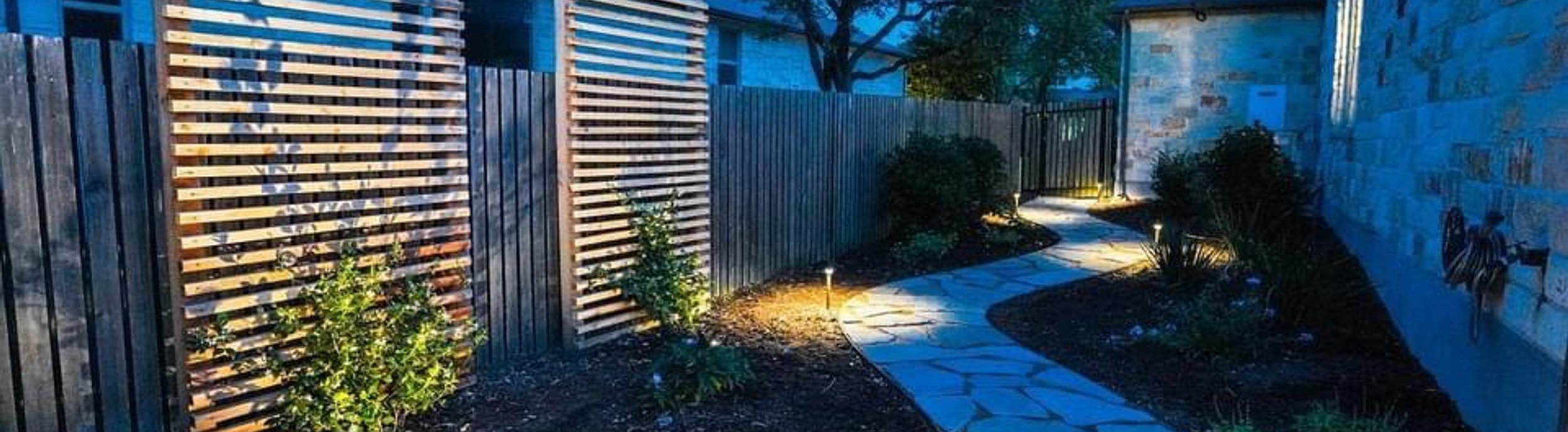
The curving Bee Cave flagstone walk at the top of this page uses a handful of path lights to carry you between the beds after dark.
Ready to build a walkway that stays flat?
A walkway ties the driveway, door, patio, and gate together, so we design it with the beds, lighting, and drainage around it. Through our design-build process, the team that draws the plan builds it.
Late fall and winter are good months for hardscape here, with no summer heat and the work done before spring planting. Call Thrive Landscape and Design at (737) 321-7812 or request a consultation. We will walk the path with you, check the grade and the trees, and give you a number you can actually compare.